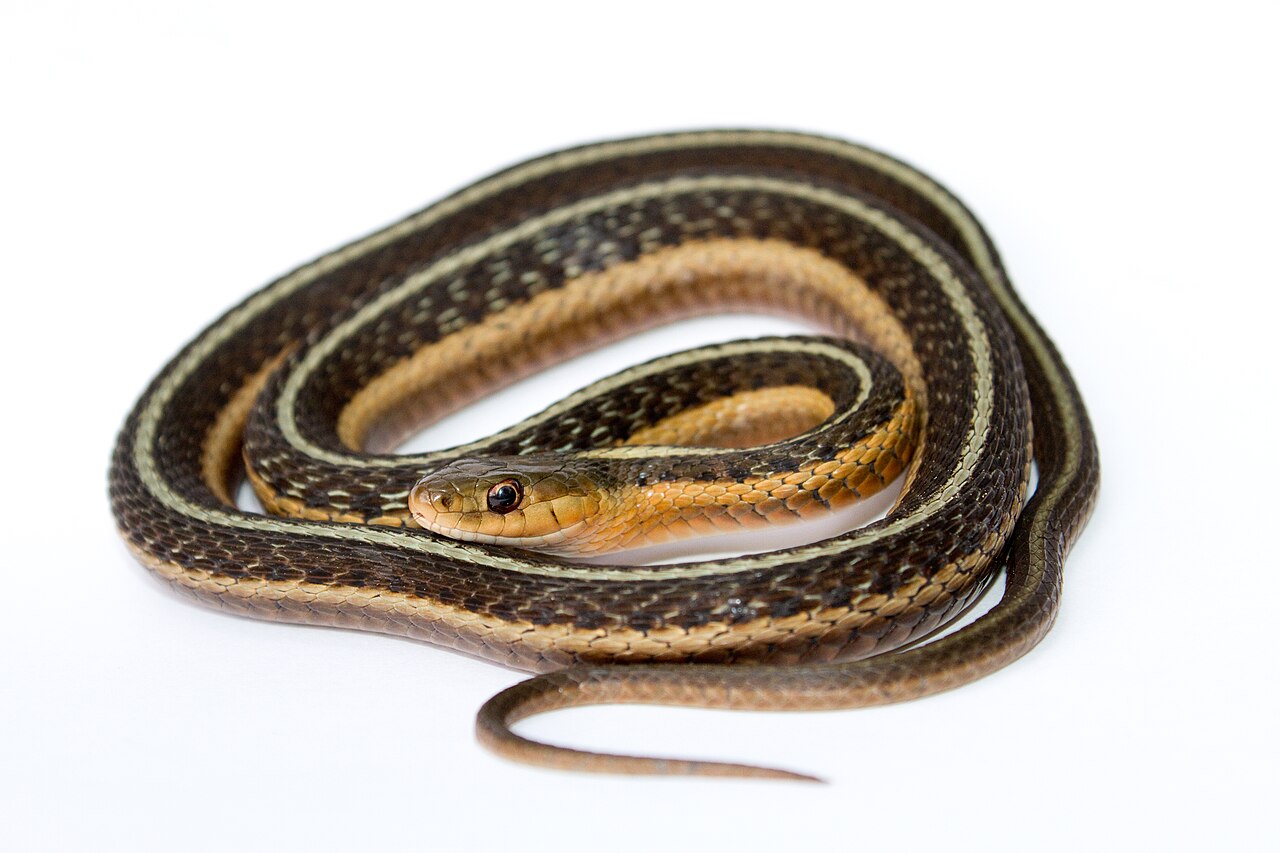
Brown Snake With Yellow Stripes: Identification Guide
A brown snake with yellow stripes in a North American yard is in many cases a garter snake (genus Thamnophis). Look for three pale stripes running from neck to tail, one down the middle of the back and one low on each side. Garter snakes are harmless to people, eat worms, slugs and frogs, and leave as soon as they get the chance.
Stripes alone do not prove the species. Ribbon snakes, Dekay’s brown snakes and young water snakes share the same browns, and a few venomous snakes live in the same yards. Pattern direction, body build and head shape settle the question.
A brown snake with lengthwise yellow stripes is most likely a garter snake or its slimmer relative, the ribbon snake. Both are harmless to people. Stripes that run from head to tail point to these snakes. Bands that cross the back in an hourglass shape point to a copperhead, which is venomous.
| Feature | Garter snake | Ribbon snake | Dekay’s brown snake | Copperhead |
|---|---|---|---|---|
| Pattern | Three pale lengthwise stripes | Three bright stripes, side stripes set higher | Pale back stripe edged by dark dots | No stripes, hourglass crossbands |
| Body build | Slender to medium | Very slender, long tail | Small and stout | Thick and heavy |
| Head and face | Barely wider than the neck | White spot in front of the eye | Small head, dark cheek mark | Broad head, slit pupils |
| Risk to people | Harmless, mild saliva | Harmless | Harmless | Venomous |
How to Identify a Brown Snake With Yellow Stripes
Identify it by counting the stripes and checking where they sit. A garter snake has three pale lengthwise stripes, one along the spine and one on each lower side, and the side stripes sit on the second and third scale rows above the belly. The stripes range from yellow to cream, greenish or orange. The ground color between them can be brown, olive or nearly black, often with a checkerboard of dark spots.
Garter snakes share a slender body, keeled scales that look ridged and dull rather than glossy, and a head only a little wider than the neck. Adults of the common garter snake (Thamnophis sirtalis) typically reach 18 to 26 inches (46 to 66 cm). Round pupils and a quick, nervous escape fit the group.
Black garter snakes with bright yellow stripes turn up in some regions, and the same three stripe rule applies to them. A checkerboard pattern with faint stripes still points to a garter snake. A snake with crossbands or blotches does not belong to this group.
Is a Garter Snake Venomous or Dangerous?
A garter snake is not dangerous to people. Its saliva contains mild secretions that help subdue frogs and fish, but the snake has no front fangs to deliver them, and the effect on humans is minor. Snakes are venomous, not poisonous. Venom enters through a bite, while poison harms when eaten or touched, so the phrase “poisonous garter snake” mixes up two different terms.
Garter snake bites leave a row of small scratches and sometimes light swelling or itching. Wash the bite with soap and water and watch it like any small cut.
A handled garter snake defends itself with smell rather than venom. It smears foul musk and feces on the hand that grabs it. Reptiles and amphibians often carry Salmonella in their digestive tracts, the CDC notes, and even healthy ones can carry the bacteria. Wash your hands after any contact.
Which Snakes Are Mistaken for Garter Snakes?
Ribbon snakes, Dekay’s brown snakes, young water snakes and young rat snakes are the snakes people confuse with garter snakes. Ribbon snakes (Thamnophis saurita and Thamnophis proximus) are thinner, with a long tail and a white spot just in front of each eye. Their side stripes sit higher, on scale rows three and four.
Baby Dekay’s brown snakes are dark gray or brown with a pale collar and no bright stripes. Adult Dekay’s brown snakes (Storeria dekayi) stay small and show two rows of dark dots along a lighter back stripe.
Brown water snakes (Nerodia taxispilota) are heavy bodied with square dark blotches, and young water snakes carry bold bands rather than stripes. Young rat snakes are gray with dark blotches. The copperhead (Agkistrodon contortrix) has tan to coppery hourglass crossbands and a broad head. It is venomous, so any banded brown snake deserves distance.
Where Brown Snakes With Yellow Stripes Are Found
Brown snakes with yellow stripes live across most of the United States and southern Canada, wherever garter snakes find cover and food. They favor damp ground near ponds, streams and ditches, along with meadows, lawns, gardens and woodpiles. Mulch beds and stone walls that stay warm and hold slugs and earthworms draw them close to houses.
Garter snakes come out early in spring and stay active into fall, often basking on warm mornings. They spend winter in shared dens with many snakes in one crevice or rock pile, and they emerge together when the ground warms.
Brown snakes carry a name shared by unrelated animals on two continents. In North America the name belongs to small, harmless Storeria species. The eastern brown snake (Pseudonaja textilis) of Australia is a different and highly venomous animal, and what you read about it does not apply to a striped snake in a US yard.
What to Do When You See a Garter Snake
Step back, give it room and let it leave on its own. Garter snakes flee from people, and a snake left alone moves on. Lead pets and children away until it is gone.
Do not catch or kill it. Garter snakes eat slugs and insects in gardens, and some kinds, such as the San Francisco garter snake, are protected by law. Reptiles can carry Salmonella on their bodies even when they look healthy and clean, the New York State Department of Health warns, which is one more reason to leave the snake alone. To make a yard less inviting, clear brush piles, keep grass short and store birdseed and pet food in sealed bins so rodents stay away.
Call a licensed wildlife professional if a snake is inside the house or if you cannot tell it from a copperhead. Seek medical care right away for any bite from a snake you cannot identify.
Frequently Asked Questions
Is there a small brown snake in Oklahoma?
Yes. Oklahoma has several small brown snakes, including Dekay’s brown snake, its Texas form, and the flathead snake (Tantilla gracilis). All three are harmless to people. They hide under leaf litter, logs and garden stones and feed on soft prey such as slugs, earthworms and insect larvae.
Which snake in Oklahoma is the most poisonous?
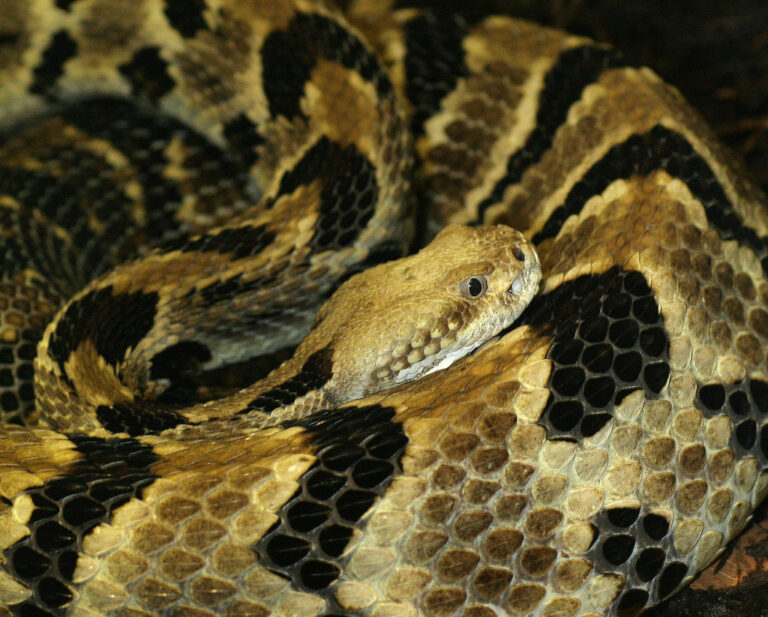
Snakes are venomous, not poisonous, and in Oklahoma large rattlesnakes such as the western diamondback and the timber rattlesnake are generally considered the most dangerous, ahead of the copperhead and the cottonmouth. Their danger depends on the snake’s size, the venom delivered and how fast the person gets care. Treat any bite from them as a medical emergency.
What snake has a 100% mortality rate?
A 100% mortality rate does not exist for any snake. Even species with very strong venom, such as Australia’s eastern brown snake, leave many bite victims alive, and fast medical care with antivenom lowers the risk sharply. Garter snakes sit far outside this group and pose little risk to people.
Does yelling scare snakes?
No. Snakes have no external ears and pick up little airborne sound, so shouting does not drive them off. They sense vibration through the ground and their jaw bones far better. Firm footsteps from a safe distance often prompt a snake to move away.
Sources
- CDC, Reptiles and Amphibians
- New York State Department of Health, Salmonella and Amphibians and Reptiles Questions and Answers
- CDC, Salmonella