Baby Alligator Snapping Turtle: ID, Care, and the Law
A baby alligator snapping turtle is a dark, heavily armored hatchling about an inch and a half long, with three pronounced rows of spiked ridges running down its shell, a large triangular head, a strongly hooked beak, and a long thick tail. It looks like a miniature dinosaur from the moment it hatches, and unlike the common snapping turtle, those spiked keels stay prominent for life rather than smoothing out with age.
The alligator snapping turtle is the largest freshwater turtle in North America, with adult males reaching 175 pounds and occasionally more, and it is a protected species across most of its range. That combination makes finding a hatchling a situation with legal as well as practical dimensions. This guide covers identification, how to separate it from the common snapper, what to do if you find one, the legal position on keeping them, and how the species differs from its more familiar relative.
A baby alligator snapping turtle is a dark hatchling about 1.5 inches long with three rows of spiked ridges on the shell, a large triangular head, and a hooked beak. It differs from a common snapper hatchling by those pronounced keels and a shorter, thicker neck. The species is protected in most states, so keeping one found in the wild is generally illegal.
| Feature | Baby Alligator Snapping Turtle |
|---|---|
| Hatchling size | About 1.5 in shell length |
| Shell | Three prominent rows of spiked ridges |
| Head | Large, triangular, strongly hooked beak |
| Adult size | Males to 175 lb; females far smaller |
| Range | Gulf drainages, southeastern United States |
| Lifespan | Estimated 50 to 100 years or more |
| Legal status | Protected in most range states |
What Does a Baby Alligator Snapping Turtle Look Like?
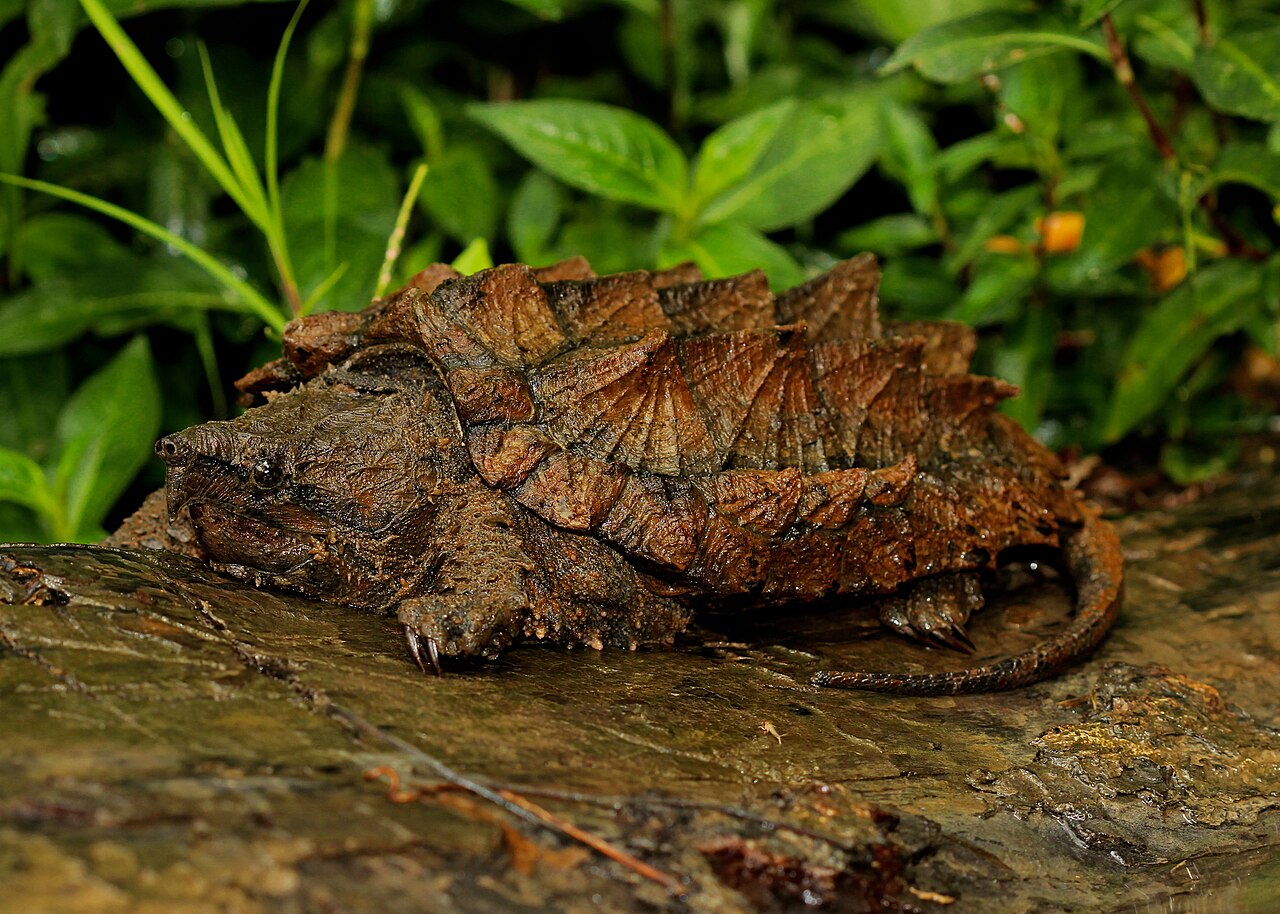
A hatchling alligator snapping turtle emerges at about an inch and a half in shell length and weighs roughly half an ounce. The carapace is dark brown to nearly black, often coated in mud, and carries three distinct rows of raised, spiked ridges called keels that run front to back. Those keels are the defining feature and they are already fully formed at hatching.
The head is disproportionately large and triangular, ending in a sharply hooked beak that gives the species its alligator-like profile. The eyes sit on the sides of the head rather than facing forward, surrounded by small fleshy projections. The tail is long and thick, nearly as long as the shell, and the skin is covered in tubercles and fleshy points that break up the animal’s outline in the water.
Hatchlings already possess the feature the species is famous for: a small pink worm-like appendage on the tongue that the turtle wriggles to lure fish within reach. Juveniles use it from an early age, sitting motionless on the bottom with the mouth open and the lure moving. This is one of the few examples of true angling behavior in any vertebrate.
How Do You Tell a Baby Alligator Snapper From a Common Snapper?
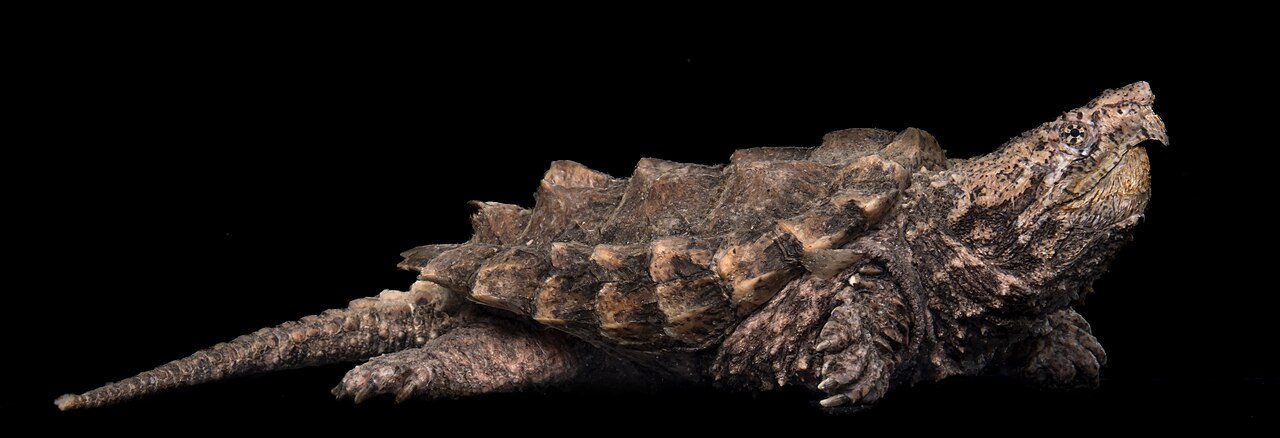
The shell keels are the fastest test. Alligator snapper hatchlings have three prominent rows of spiked ridges that are obvious to the eye and to the touch. Common snapping turtle hatchlings have much lower keels that flatten out as the animal grows, and an adult common snapper’s shell is comparatively smooth.
Head and neck shape confirm it. The alligator snapper has a broader, more triangular head with a strongly hooked beak and a relatively short, thick neck. The common snapper has a narrower head and a notably long, flexible neck that it can extend surprisingly far, which is exactly why common snappers are more dangerous to handle: they can reach much further back along their own shell.
Eye position is a further check. Alligator snapper eyes sit on the sides of the head and are surrounded by small fleshy projections, so you cannot see both eyes at once from directly above. Common snapper eyes are placed more toward the top and are visible together from above. Range helps too: alligator snappers occur only in river systems draining into the Gulf of Mexico, from Florida to eastern Texas and north up the Mississippi drainage, while common snappers range across most of the eastern and central United States. The baby snapping turtle guide covers the common species in detail.
What Should You Do if You Find One?
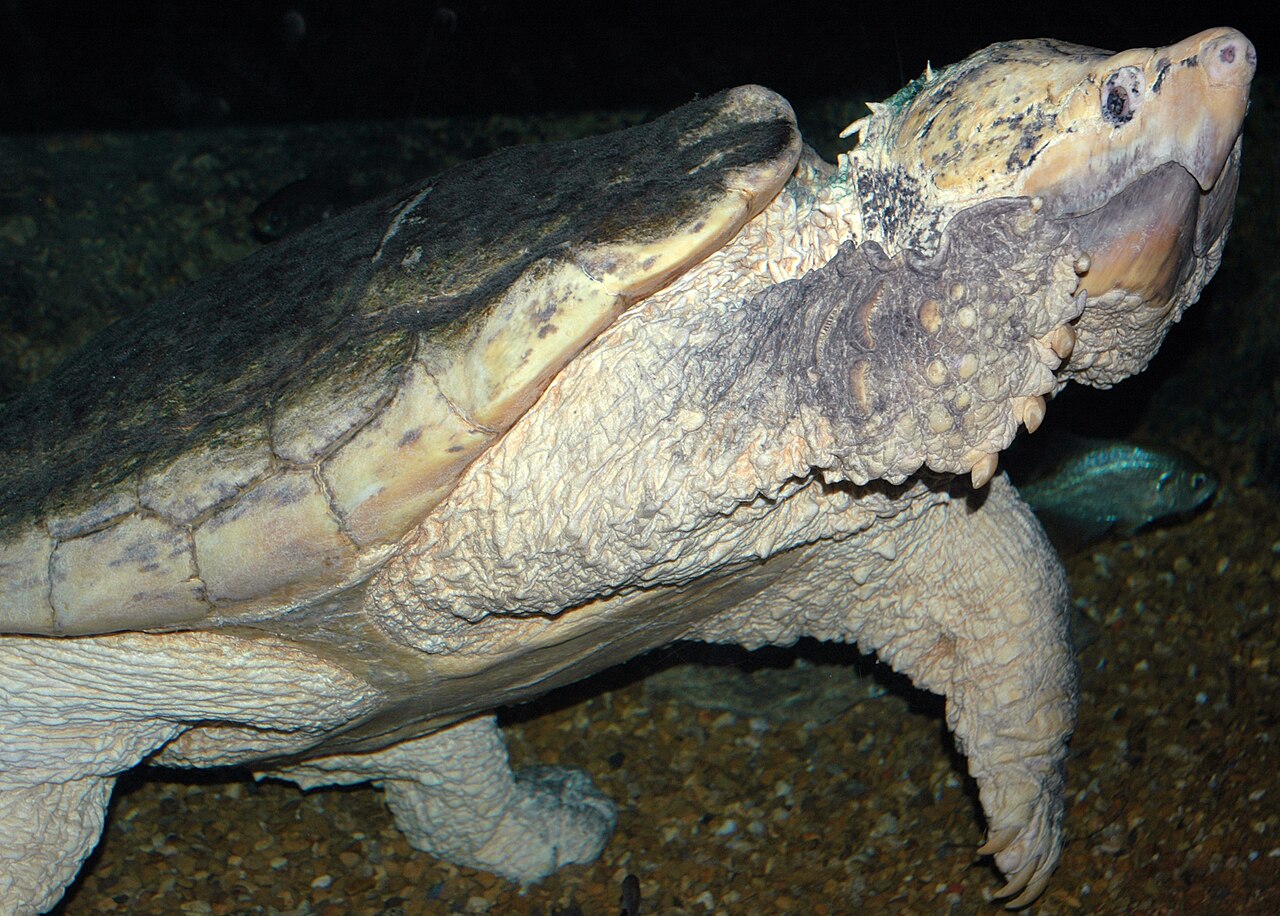
Leave it alone and let it continue in the direction it was heading. A hatchling moving across land is doing exactly what it should: alligator snapping turtles nest on land, usually within a few hundred feet of water, and the hatchlings emerge in late summer or autumn and travel to the nearest water on their own. Interfering with that journey rarely helps and often harms.
If it is on a road, moving it across in the direction it was already facing is appropriate, and it is the one intervention that is unambiguously useful. Hatchlings are small enough to pick up safely by the sides of the shell, though even a hatchling can deliver a surprising bite, so handle it by the rear half of the shell and keep fingers away from the head. Never pick up any snapping turtle by the tail, which can dislocate vertebrae; this matters more for larger animals.
Do not take it home. Beyond the legal problems covered below, hatchling survival in captivity without proper setup is poor, and removing an animal from a protected population has real conservation consequences. Alligator snapping turtles take 11 to 21 years to reach breeding age and females lay a single clutch a year at most, so every individual removed represents decades of lost reproduction. If the animal is visibly injured, contact a licensed wildlife rehabilitator rather than attempting care yourself.
Is It Legal to Keep an Alligator Snapping Turtle?
In most of its range, no. The alligator snapping turtle is listed as threatened, endangered, or otherwise protected in the majority of states where it occurs, including Georgia, Florida, Alabama, Indiana, Illinois, Kentucky, Missouri, Tennessee, and others, and collecting wild individuals is prohibited. The U.S. Fish and Wildlife Service proposed federal listing under the Endangered Species Act in 2021.
The rules vary considerably by state, and some permit possession of captive-bred animals with documentation while prohibiting wild collection entirely. Several states outside the natural range prohibit possession altogether because of the risk of released animals establishing populations. Anyone considering one as a pet needs to check their own state wildlife agency directly, since the situation changes and generic advice online is frequently out of date.
Captive-bred hatchlings are available from breeders in some jurisdictions, typically for a few hundred dollars, but the animal is a poor pet for almost everyone. A single adult needs a pond or a tank of several hundred gallons, lives 50 to 100 years or more, cannot be handled safely, and represents a commitment that will outlast most owners. Releasing an unwanted one is illegal and ecologically damaging.
Are Alligator Snapping Turtles Aggressive?
Not in the way their reputation suggests. Alligator snapping turtles are ambush predators that spend nearly all their time motionless on the bottom, and in water they almost invariably retreat or stay still rather than approach a person. Swimmers in alligator snapper habitat are essentially never bitten, because the animal has no interest and no reason to pursue.
On land the picture changes, and this applies to all snapping turtles. Out of water they cannot retreat into the shell the way most turtles can, since the plastron is reduced, so their only defense is the bite. An alligator snapper on land will lunge and snap at a perceived threat, and an adult’s bite is genuinely capable of serious injury, with bite force measurements in the range of several hundred pounds.
Common snapping turtles are actually more likely to bite a person, because they are far more numerous, encountered more often on land, and have that long extensible neck. The alligator snapper’s reputation is inflated partly by size and appearance and partly by persistent myths, including the frequently repeated claim that they can bite through a broomstick or sever fingers casually. The snapping turtle bite guide covers what the bite can and cannot do.
How Big Do They Get and How Fast?
Growth is slow and the endpoint is enormous. From a one-and-a-half-inch hatchling, an alligator snapping turtle takes 11 to 21 years to reach sexual maturity, and males continue growing throughout life. Verified large males exceed 175 pounds, and the largest reliably documented specimens approach 250 pounds. Females are considerably smaller, typically topping out around 50 to 60 pounds.
Claims of 400-pound alligator snappers circulate widely and are not supported by verified records. The frequently cited 403-pound animal from Kansas in 1937 was never scientifically confirmed. The largest well-documented wild individuals are in the 200 to 250 pound range, which is still by a wide margin the heaviest freshwater turtle in North America.
Lifespan estimates run from 50 to well over 100 years, and because the species has been studied for a relatively short time compared with its longevity, the upper end is uncertain. This extreme slow-life strategy, late maturity, low reproductive output, and great longevity, is exactly what makes the species vulnerable: populations cannot absorb adult losses, and recovery from historic harvesting for turtle soup has been slow.
What Do Baby Alligator Snapping Turtles Eat?
Hatchlings eat small aquatic invertebrates, insect larvae, worms, small fish, crayfish, and carrion, a diet closer to that of a young painted turtle than to the adult’s, and they begin using the tongue lure early. As they grow, fish become the dominant prey, alongside crayfish, mussels, snails, amphibians, smaller turtles, and occasionally small mammals and birds that come to the water. Adults also eat a meaningful amount of plant material, particularly acorns and other nuts that fall into the water.
The lure is what makes them distinctive. An alligator snapper sits on the bottom with its mouth open and wriggles the pink appendage on its tongue, which resembles a worm closely enough that fish approach and are taken with a snap fast enough to be difficult to see. The turtle may sit motionless for 40 to 50 minutes between breaths, and this ambush strategy costs almost no energy.
Feeding is concentrated at night in adults, and the animals are almost entirely aquatic, with females leaving the water only to nest. This near-total aquatic life is another difference from common snappers, which move overland more readily and turn up in yards and on roads far more often. The baby turtle guide covers dietary needs across species.
Why Are Alligator Snapping Turtles Declining?
Historic harvesting is the main cause. Alligator snapping turtles were taken commercially in large numbers through the mid-twentieth century for meat and for turtle soup, with one Louisiana operation reportedly processing tens of thousands of pounds annually, and populations across the range were severely depleted before protection arrived. Given how slowly the species reproduces, those losses have taken decades to begin recovering from.
Ongoing pressures include habitat loss from river channelization, dredging, and dam construction, which removes the deep pools and submerged logs the species depends on, along with bycatch on trotlines and in fishing gear, and illegal collection for the pet trade. Nest predation is heavy in developed areas, largely by raccoons, and the coyotes and other mesopredators that thrive alongside people.
Recent taxonomic work has complicated conservation further. Research published in 2014 proposed splitting the alligator snapping turtle into multiple species, including the Suwannee alligator snapping turtle of Florida’s Suwannee River drainage, which would make each resulting population smaller and more vulnerable than the single species appeared to be. Conservation programs including headstarting, in which hatchlings are raised in captivity past the most vulnerable stage before release, operate in several states.
Frequently Asked Questions
What does a baby alligator snapping turtle look like?
A dark hatchling about 1.5 inches long with three prominent rows of spiked ridges on the shell, a large triangular head with a hooked beak, and a long thick tail. It already has the pink worm-like tongue lure at hatching.
How do you tell a baby alligator snapper from a common snapper?
The keels. Alligator snapper hatchlings have three pronounced rows of spikes that persist for life; common snapper keels are low and flatten with age. Alligator snappers also have a shorter, thicker neck and side-placed eyes.
What should I do if I find a baby alligator snapping turtle?
Leave it to continue in the direction it was heading, or move it across a road in that same direction. Do not take it home. The species is protected in most range states and hatchling survival in improper captivity is poor.
Are alligator snapping turtles aggressive?
Not in water, where they retreat or stay still. On land they cannot withdraw into the shell and will lunge and snap defensively. Common snapping turtles actually bite people more often because of their longer neck and more frequent land travel.
Can you keep an alligator snapping turtle as a pet?
In most range states, collecting a wild one is illegal, and some states prohibit possession entirely. Even where captive-bred animals are legal, they need hundreds of gallons of water, live 50 to 100 years or more, and cannot be handled safely.
How big do alligator snapping turtles get?
Males reach 175 pounds with the largest verified individuals approaching 250, making them the heaviest freshwater turtle in North America. Females top out around 50 to 60 pounds. Claims of 400-pound animals are unverified.
Where do baby snapping turtles go after hatching?
They travel from the land nest directly to the nearest water, usually within a few hundred feet, emerging in late summer or autumn. Most losses happen during that short journey, to raccoons, birds, and vehicles.