9 Bugs That Look Like Silverfish and How to Tell Them Apart
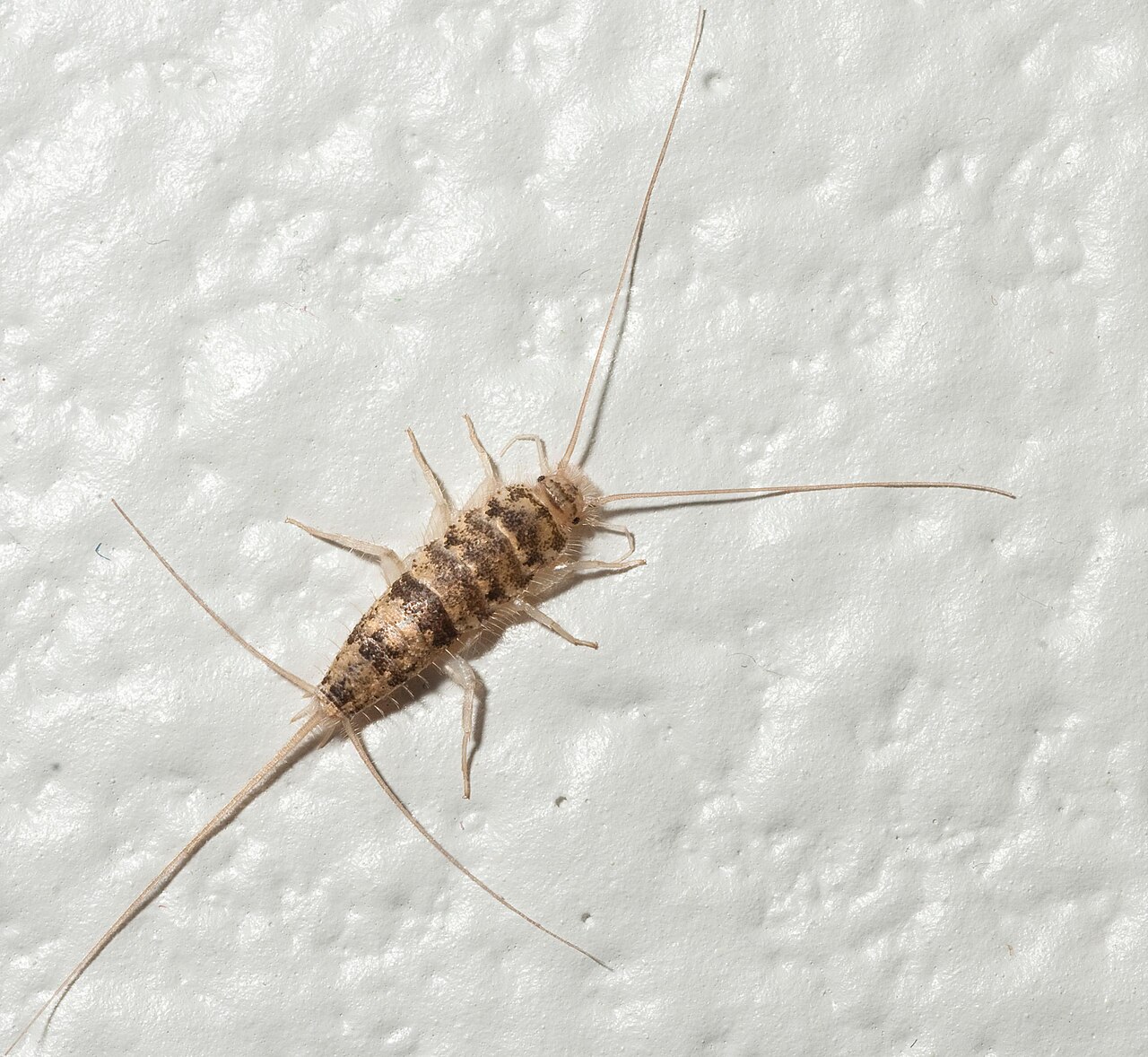
Most bugs that look like silverfish are firebrats, jumping bristletails, booklice, earwigs, carpet beetle larvae, or young cockroaches, and telling them apart takes about ten seconds once you know what to check. A true silverfish (Lepisma saccharinum) is a flat, wingless, teardrop shaped insect with metallic gray scales, two long antennae in front, and three tail filaments at the back. If the bug in your bathroom is missing any of those three tails, it is something else.
The distinction matters because the lookalikes call for different responses. Silverfish and firebrats eat starch and paper and are a nuisance. Carpet beetle larvae eat wool and stored food. Cockroach nymphs signal a problem that grows fast. This guide walks through the nine bugs most often mistaken for silverfish in United States homes and gives the one feature that separates each from the real thing.
Bugs commonly mistaken for silverfish include firebrats, jumping bristletails, booklice, earwigs, carpet beetle larvae, cockroach nymphs, house centipedes, and springtails. True silverfish are flat, scaly, silver gray, wingless, and carry three tail filaments plus two long antennae. Count the tails and check for wings to identify the insect correctly.
| Insect | Size | Telling Feature | Risk in the Home |
|---|---|---|---|
| Silverfish | 0.5 to 0.75 in | Silver scales, three tails, no wings | Damages paper, books, starch |
| Firebrat | 0.5 in | Mottled gray and brown, three tails, loves heat | Same damage, hotter rooms |
| Jumping bristletail | 0.4 to 0.6 in | Humped back, huge eyes, jumps | Outdoor only, harmless |
| Booklice | 0.04 in | Pale, soft, no tails, moves in groups | Signals dampness or mold |
| Earwig | 0.5 to 1 in | Rear pincers, brown, may have short wings | Occasional invader |
| Carpet beetle larva | 0.15 to 0.2 in | Bristly hairs, brown bands, slow | Eats wool, silk, stored food |
| Cockroach nymph | 0.1 to 0.5 in | Two tails, oval body, fast | Serious, breeds quickly |
How to Tell a True Silverfish From a Lookalike
Three checks separate a silverfish from everything else: count the tail filaments, look for wings, and watch how it moves. A silverfish has exactly three tails of roughly equal length spreading like a trident, no wings at any life stage, and a distinctive side to side wriggle that looks like a fish swimming across the floor. That wriggle is where the common name comes from.
Next check the body outline. Silverfish taper steadily from a broad thorax to a narrow abdomen, giving a carrot or teardrop shape, and the whole body is covered in fine metallic scales that rub off on your fingers. Beetle larvae are cylindrical and hairy, cockroach nymphs are flat ovals of even width, and booklice are soft, pale, and almost featureless at that size.
Finally, note where you found it. Silverfish want humidity above 75 percent and temperatures of 70 to 80 F (21 to 27 C), which is why bathrooms, basements, and the space under kitchen sinks produce most sightings. An insect found in a dry attic in July is far more likely to be a firebrat. Young silverfish are white and much smaller than adults, and we cover that stage in detail in our guide to baby silverfish.
Firebrats: The Closest Lookalike of All
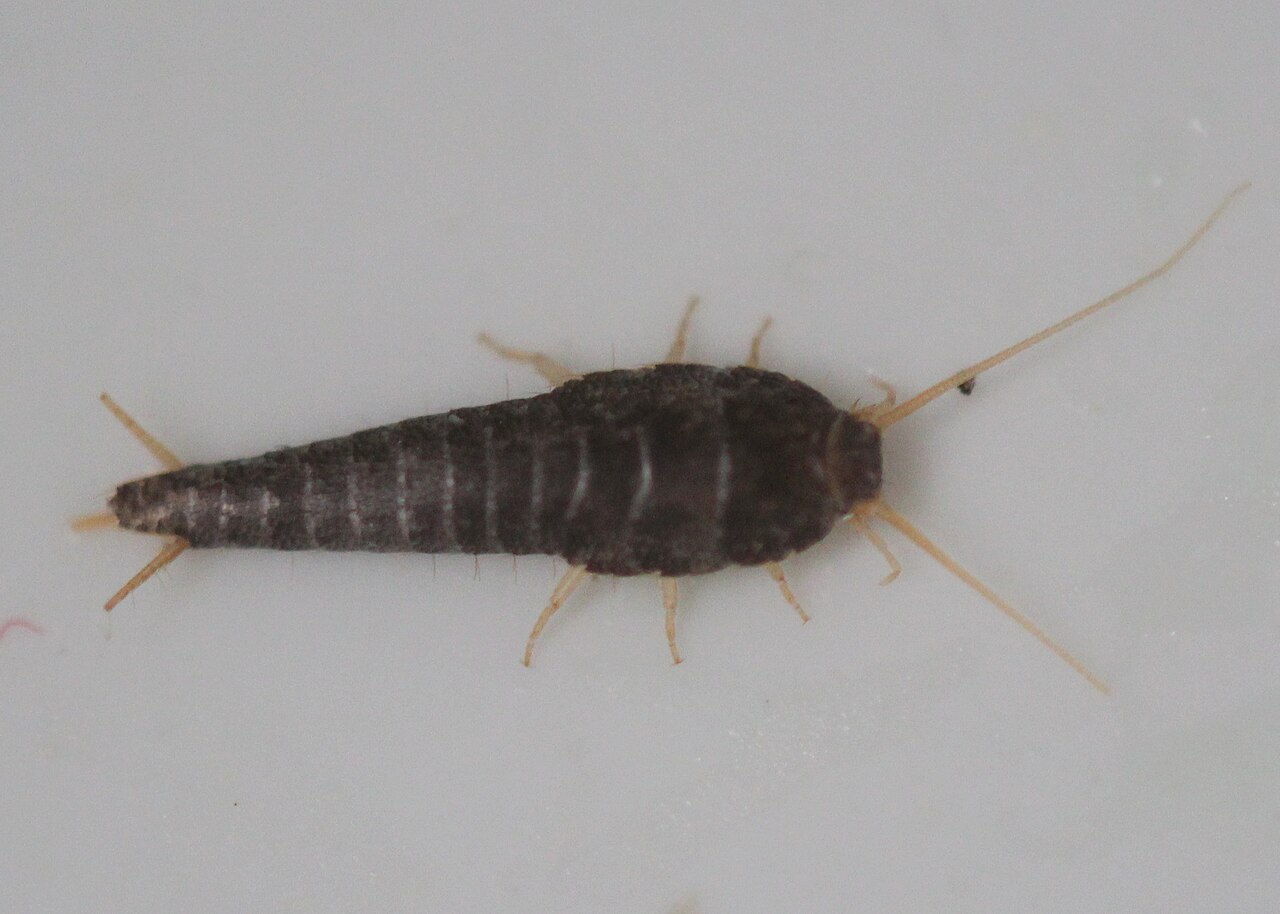
The firebrat (Thermobia domestica) is the insect most often mistaken for a silverfish, because it belongs to the same order and shares the same body plan down to the three tails. The difference is color and pattern: a firebrat is mottled brown and gray with dark speckling rather than uniform metallic silver, and its antennae are longer relative to the body.
Temperature preference separates them in practice. Firebrats seek out heat, thriving at 90 to 106 F (32 to 41 C), which puts them around water heaters, furnaces, ovens, boiler rooms, bakeries, and the insulation near hot pipes. Silverfish avoid those places. If your sighting came from beside the furnace rather than the shower, you almost certainly have firebrats.
The damage they cause is identical: both feed on carbohydrates, so they graze on paper, book bindings, wallpaper paste, cardboard, flour, cereal, and even the sizing in fabric. Neither bites, neither carries disease, and neither will damage your home structurally. Both indicate the same underlying condition, which is undisturbed clutter plus the humidity or heat they prefer.
Jumping Bristletails: The Outdoor Version
Jumping bristletails (order Archaeognatha) look like silverfish that spent the winter lifting weights. They carry the same three tails and scaly body, but the thorax is strongly humped, the eyes are large and meet at the top of the head, and the body is more cylindrical than flat. They are typically 0.4 to 0.6 in (10 to 15 mm) long.
Their behavior gives them away immediately. When disturbed, a bristletail snaps its abdomen against the ground and launches itself several inches into the air. A silverfish never jumps; it runs. Anyone who has lifted a stone in the yard and watched a silver insect leap has met a bristletail, not a silverfish.
Bristletails live outdoors under bark, leaf litter, and rocks, feeding on algae, lichen, and decaying plant matter. They cannot establish indoors because they need consistently damp conditions, so an indoor sighting is a wanderer that came in on firewood or through a gap in a foundation. No treatment is needed beyond sealing the entry point.
Earwigs: The Brown Bugs That Look Like Silverfish
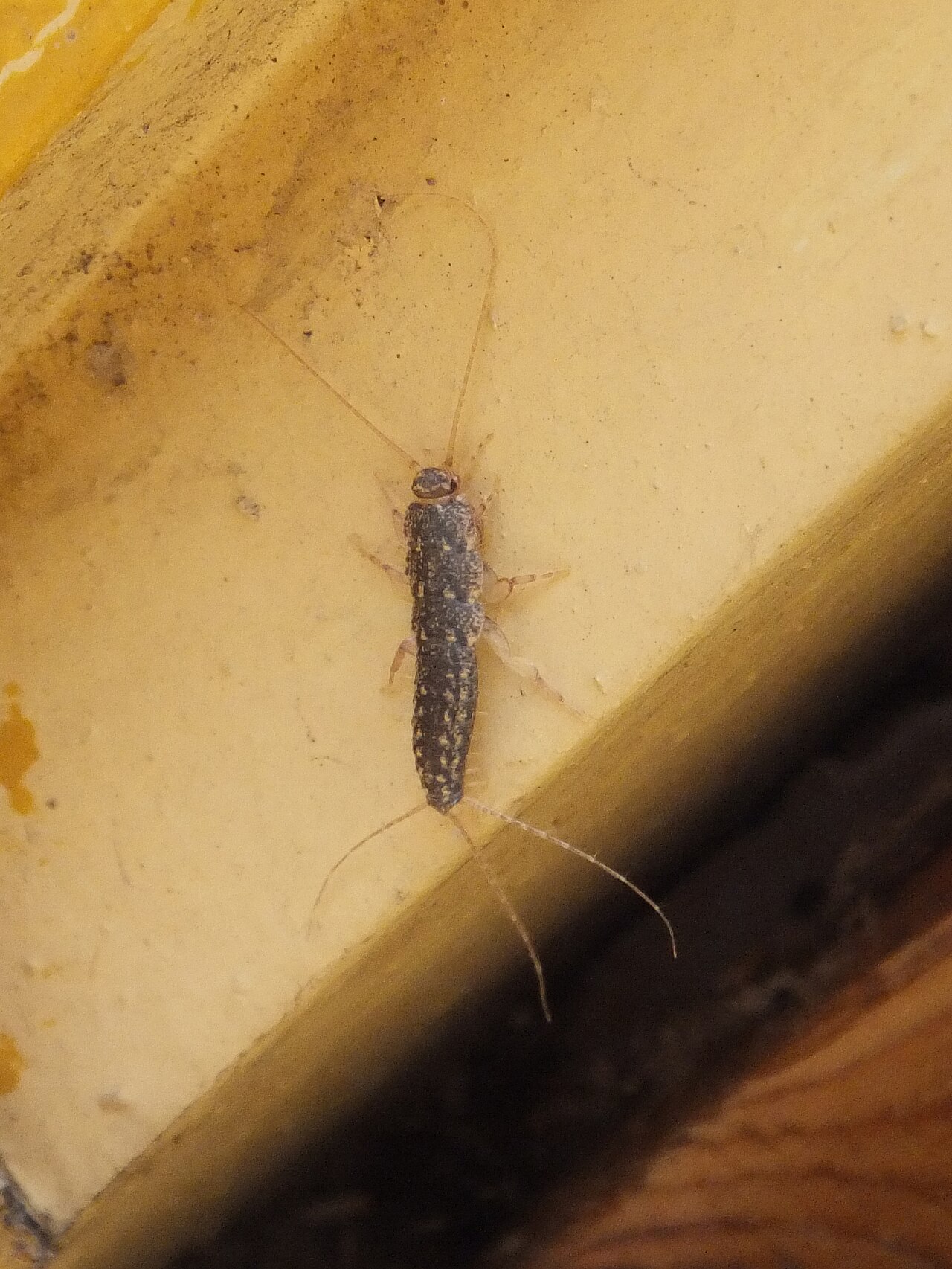
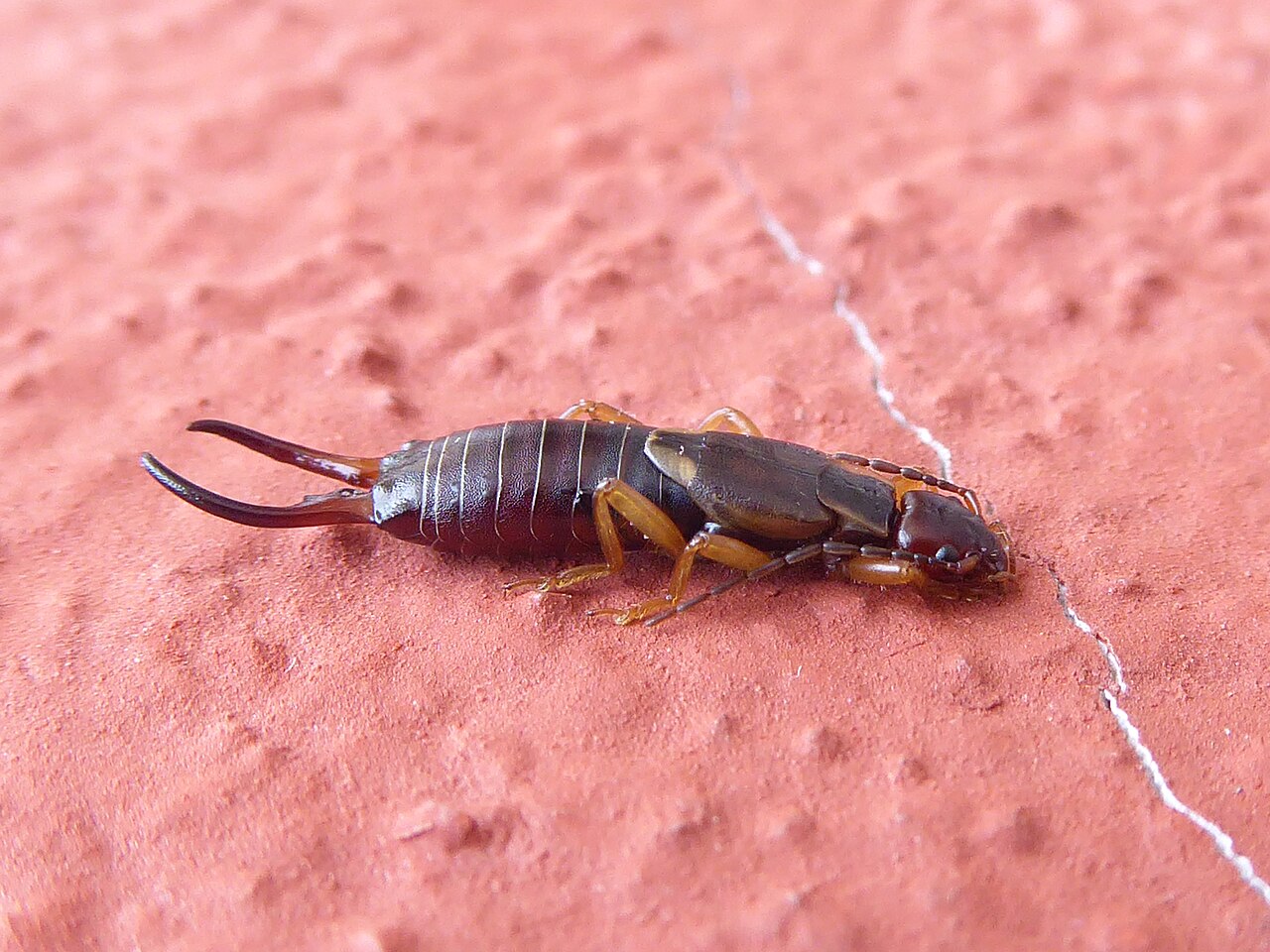
Earwigs are the answer when someone searches for brown bugs that look like silverfish. The European earwig (Forficula auricularia) has a long, flattened, reddish brown body that reads as silverfish shaped from a distance, but the rear end carries a pair of curved pincers called cerci instead of three soft filaments. Those pincers settle the identification instantly.
Earwigs also have short leathery wing covers across the shoulders, and most species can fly, though they rarely bother. They move faster than silverfish and tend to curl the abdomen upward when threatened. Adults run 0.5 to 1 in (13 to 25 mm), noticeably larger than a typical silverfish.
Indoors they are accidental invaders drawn in by moisture, and they die off quickly in dry rooms. Outdoors they feed on decaying plant matter, aphids, and soft plant growth, which makes them a mixed blessing in a garden. We cover the species in detail in our profile of the house earwig, and the practical removal steps in how to get rid of earwigs.
Booklice: Tiny Bugs That Look Like Silverfish in Paper
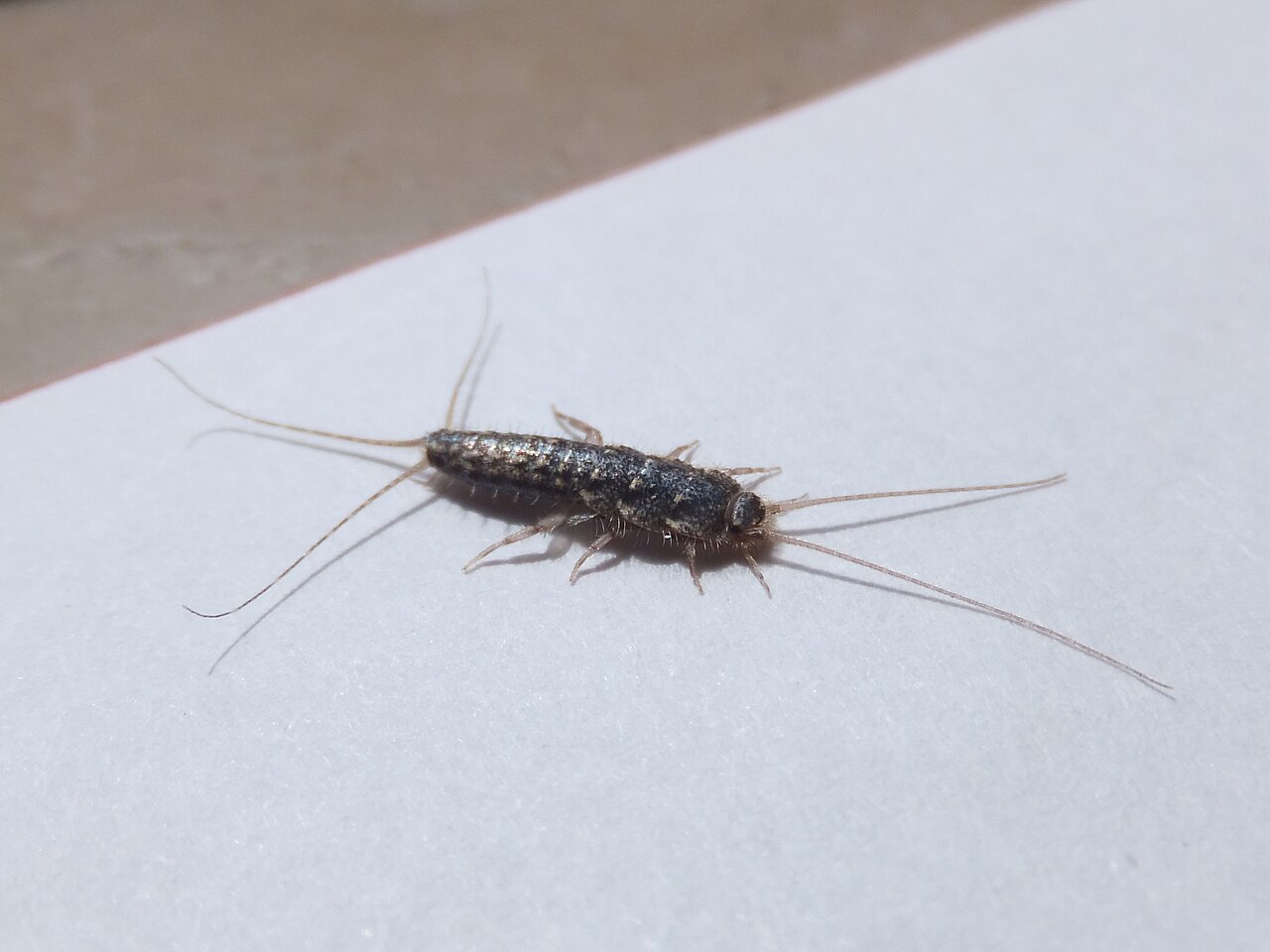
Booklice, also called psocids (Liposcelis species), are the usual answer when someone finds tiny bugs that look like silverfish around books, cardboard, or stored food. They are only 0.04 in (1 mm) long, pale cream to light brown, soft bodied, and wingless in the indoor species. At that size the eye registers a small pale insect moving in a jerky line, which is close enough to a young silverfish to cause confusion.
The differences appear under magnification or a phone camera. Booklice have no tail filaments at all, a large bulbous head with a swollen area behind the eyes, and short antennae. Silverfish, even as newly hatched nymphs, already show the three tails and the tapered shape.
Booklice feed on microscopic mold rather than on paper directly, which makes them a humidity indicator more than a pest. Finding them means a relative humidity above 60 percent somewhere in the room. Drop the humidity below 50 percent with a dehumidifier or better ventilation and the population collapses within two weeks without any insecticide.
Carpet Beetle Larvae: Small, Bristly, and Damaging
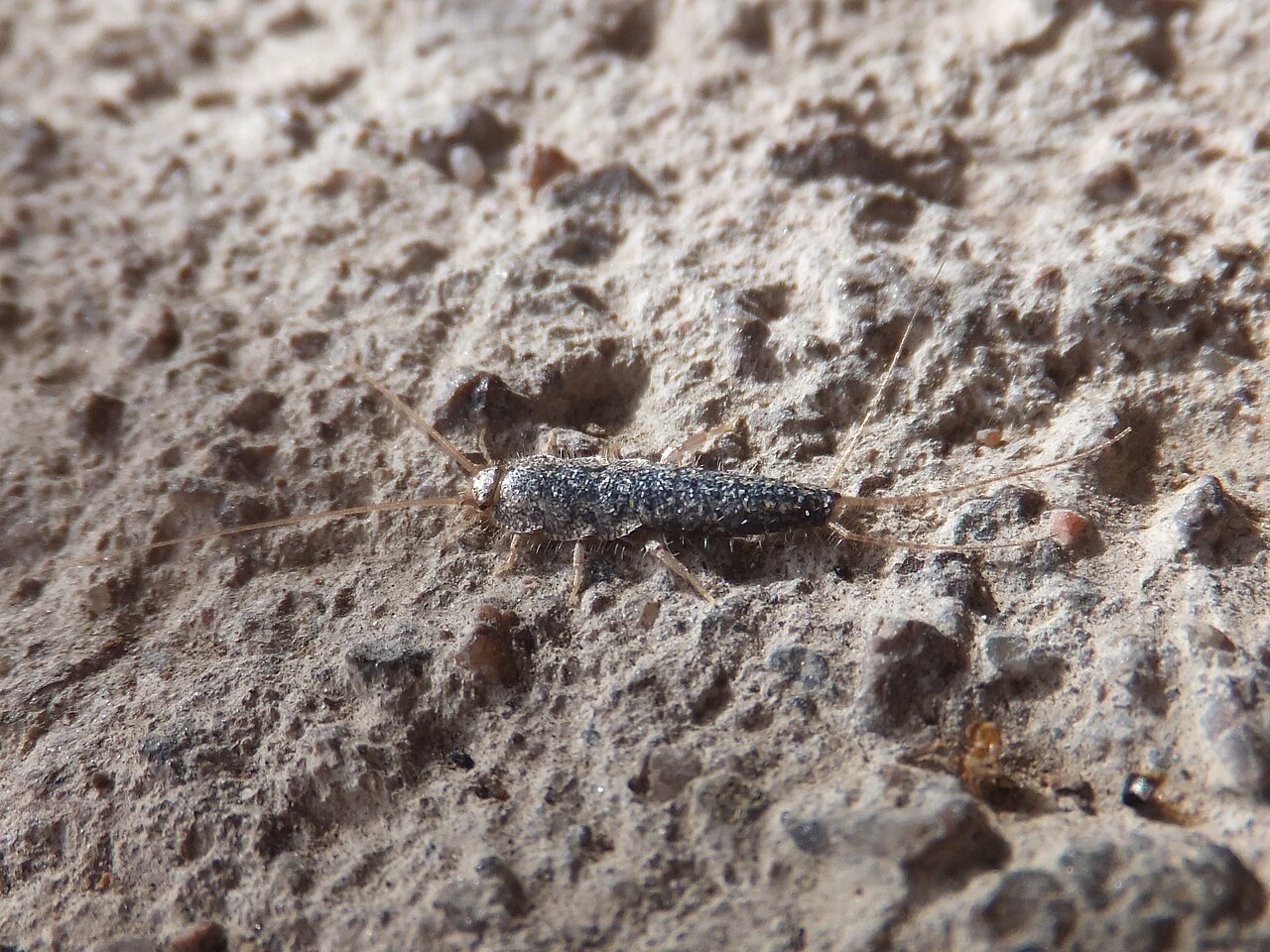
Carpet beetle larvae are mistaken for silverfish because of their size, brown color, and habit of appearing along baseboards and in closets. The larva of the varied carpet beetle (Anthrenus verbasci) is about 0.2 in (5 mm) long, banded light and dark brown, and covered in stiff bristles that form a small tuft at the rear. That tuft is sometimes read as tails.
Movement separates them clearly. Carpet beetle larvae crawl slowly and often curl up when touched, while silverfish dart for cover the moment a light comes on. The larvae also leave behind shed skins that look like tiny hollow versions of the insect, a trace silverfish do not produce.
The stakes are higher with carpet beetles. Their larvae digest keratin, so they feed on wool rugs, sweaters, felt, silk, taxidermy, and pet hair collected under furniture. Damage shows as irregular holes in stored wool rather than the surface grazing silverfish leave on paper. Our guide to carpet beetle larvae covers identification and cleanout in full.
Cockroach Nymphs: The Lookalike You Do Not Want
Young German cockroaches (Blattella germanica) are the most consequential silverfish lookalike, because a misidentification delays treatment on an infestation that doubles roughly every month. Early nymphs are 0.1 to 0.2 in (3 to 5 mm) long, dark brown, and flat, and they run along walls at night just as silverfish do.
Count the tails again. Cockroach nymphs have two cerci, not three, and they lack the long middle filament. They also show two pale stripes running down the back of the thorax, they are never metallic, and their legs are visibly spiny. A silverfish tapers toward the rear, while a roach nymph keeps a nearly uniform oval width.
Other evidence follows a roach and never a silverfish: dark pepper like droppings in cabinet corners, a musty odor in a heavy infestation, and small brown egg cases. If you see any of those, treat it as a cockroach problem immediately. The related confusion between bed bugs and small roaches is covered in bed bug versus baby cockroach.
House Centipedes and Other Fast Movers
The house centipede (Scutigera coleoptrata) gets grouped with silverfish because both appear suddenly in bathrooms at night and both move in a rippling, fluid way. The centipede is unmistakable once you get a real look at it, with 15 pairs of long banded legs and a body up to 1.5 in (38 mm) including the legs, but a glimpse at the edge of vision often registers only as a fast gray streak.
House centipedes are predators, and silverfish are on the menu along with cockroach nymphs, spiders, and carpet beetle larvae. Their presence usually means the house has a supply of smaller insects to support them. Killing the centipedes without fixing the moisture that feeds the prey population accomplishes little.
They are harmless to people in practical terms. A house centipede can technically bite, but the jaws rarely break human skin, and there are no venom effects of consequence. Our full profile of the house centipede covers the species and how to keep numbers down.
Springtails: Tiny Bugs in the Bathroom
Springtails (order Collembola) show up in the same damp bathroom corners as silverfish and are frequently described as tiny silver bugs that are not silverfish. They measure 0.02 to 0.1 in (0.5 to 2.5 mm), come in gray, white, or dark blue, and appear in large numbers around drains, potted plants, and condensation on window frames.
Their signature is the jump. A springtail carries a forked appendage under the abdomen that snaps against the surface and flings the insect several inches, so a cluster scatters like sprayed water when you approach. Silverfish run in a straight line for the nearest crack and never leave the ground.
Springtails feed on mold, algae, and decaying organic matter, and they cannot damage your home or bite you. Like booklice, they are a reading on the humidity gauge. Fix the leak, run the exhaust fan, let the sink cabinet dry out, and they leave on their own.
Bugs That Look Like Silverfish With Wings
If the insect has wings, it is not a silverfish, because silverfish are wingless at every life stage. The most common winged confusions are termite alates, flying ants, and small brown moths. Termite swarmers have two pairs of equal length wings, a straight waist, and straight antennae, and they shed their wings in piles on window sills, which is a sign worth acting on quickly.
Flying ants have a pinched waist, elbowed antennae, and front wings noticeably longer than the hind pair. Neither resembles a silverfish up close, but both are pale brown, similar in length, and appear indoors in sudden numbers, which is enough for a quick glance to land on the wrong insect.
Adult carpet beetles also fly, and they are small, rounded, and mottled. They gather at windows in spring because they are trying to get outside to feed on pollen. Their presence indoors in spring usually means larvae have already been feeding somewhere in the house.
Is My House Dirty If I Have Silverfish?
A silverfish sighting is not evidence that your house is dirty. Silverfish respond to humidity and shelter, not to crumbs, and spotless homes with a damp basement or a poorly ventilated bathroom produce them reliably. Old apartment buildings, stone foundations, and houses on shaded lots see them regardless of housekeeping.
What clutter does is give them cover and food. Stacks of newspapers, cardboard storage boxes, unopened mail, and packed bookshelves all offer both at once, which is why a rarely opened closet produces more sightings than a busy kitchen. Undisturbed is the operative word, not unclean.
The University of California statewide pest management program describes silverfish as household nuisance pests tied to moisture rather than sanitation, and its identification pages at ipm.ucanr.edu are the most reliable free reference for separating them from the insects in this guide.
How Do I Get Rid of Silverfish Bugs?
You get rid of silverfish bugs by removing the humidity they depend on, then cleaning up the food and shelter that hold them. Run a dehumidifier to bring indoor relative humidity below 50 percent, use the bathroom exhaust fan during and after every shower, fix dripping traps and supply lines, and ventilate the basement. Populations drop sharply once the air dries out, because eggs fail to hatch below about 50 percent humidity.
Then take away the pantry. Move flour, cereal, oats, and pet food into sealed glass or hard plastic containers, replace cardboard storage boxes with lidded plastic bins, and get old newspapers and paper bags out of closets and garages. Vacuum baseboards, wall voids around pipes, and bookshelf edges, then seal cracks with caulk.
Where treatment is needed, sticky traps along baseboards confirm the size of the problem, and a thin dusting of diatomaceous earth or boric acid in wall voids, under sinks, and behind appliances works slowly but reliably. Mixed populations of other small crawlers, including the tiny red clover mites that invade in spring, respond to the same sealing and vacuuming routine.
Related reading: what does a tick bite look like.
Related reading: Caterpillars That Look Like Snakes.
Related reading: bugs that look like cockroaches.
Related reading: Bugs That Look Like Ducks.
Related reading: bugs that look like stink bugs.
Related reading: Bugs That Look Like Spiders.
Related reading: Animals That Look Like Ferrets.
Related reading: what do chigger bites look like.
Related reading: Animals That Look Like Raccoons.
Related reading: bugs that look like mosquitoes.
Related reading: spiders that look like black widows.
Related reading: bugs that look like termites.
Related reading: bugs that look like boxelder bugs.
Frequently Asked Questions
Should I be worried if I see silverfish?
Not for your health. Silverfish do not bite, sting, or carry disease. The concern is property: they graze on paper, book bindings, wallpaper paste, photographs, and stored starches. Repeated sightings also flag a moisture problem, and that is worth investigating, since the same dampness invites mold, booklice, and springtails.
Can silverfish live in your bed?
They can pass through a bed but will not live in it. Silverfish need humidity above 75 percent and a food source of starch or paper, and a slept in bed offers neither. Occasional appearances on bedding usually come from a damp adjoining bathroom or from cardboard stored under the frame.
Can silverfish infest your hair?
No. Silverfish cannot grip hair, do not feed on skin or keratin from a living host, and have no interest in people. An insect actually living in hair is a head louse, which is a different order entirely and is far smaller. Silverfish crossing a pillow are passing through, not settling in.
What smell do silverfish hate?
Cedar oil, lavender, citrus peel, cinnamon, and bay leaves all repel silverfish to some degree, and cedar wood is the most consistently effective of the group. Treat scent as a supporting measure only. Lowering humidity below 50 percent does more in a week than any repellent does in a month.
Will silverfish ever go away?
They will, but only when the conditions change. Silverfish live 2 to 8 years and breed slowly, so a population left alone in a damp basement persists for years. Dry the space below 50 percent relative humidity, seal food and paper, and the colony dies out over several weeks.
What month are silverfish most active?
Activity peaks from June through September, when indoor humidity is highest and warm nights suit them. In heated homes they stay active all year, and a second bump often comes in late winter when condensation forms on cold exterior walls. Sightings rise whenever humidity does, not with any calendar date.