Hummingbird Moth: Species, ID, and Why Wings Turn Clear
A hummingbird moth is a day-flying sphinx moth that hovers at flowers, feeds through a long tongue, and moves so much like a hummingbird that people routinely report seeing a tiny bird. In North America the ones you are most likely to meet are the hummingbird clearwing and the snowberry clearwing, both about 1.5 to 2 in across with partly transparent wings.
They are harmless, they are excellent pollinators, and the transparent wings have an unusual explanation: the scales are there when the moth emerges and fall off during the first flight, leaving clear windows behind. This guide covers the species you can find, how to tell one from an actual hummingbird, the caterpillars, where they overwinter, and how to bring them into a garden.
| Quick Facts | Hummingbird Moths |
|---|---|
| Family | Sphingidae, the sphinx or hawk moths |
| Wingspan | 1.5 to 2 in for the common clearwings |
| Active | Daytime, unlike most moths |
| Feeding | Nectar through a long proboscis while hovering |
| Host plants | Honeysuckle, snowberry, viburnum, hawthorn |
| Sting or bite | None, completely harmless |
What Is a Hummingbird Moth?
Hummingbird moths belong to the family Sphingidae, a group of roughly 1,450 species worldwide known for powerful, fast flight and streamlined bodies. Most sphinx moths fly at dusk or at night, but the hummingbird moths are day-active, which is why people see them at all.
The name covers several species rather than one. In North America it usually means one of the clearwings in the genus Hemaris, while in Europe it means the hummingbird hawk-moth (Macroglossum stellatarum), and in the southwest it often means the white-lined sphinx, which is larger and flies at dusk.
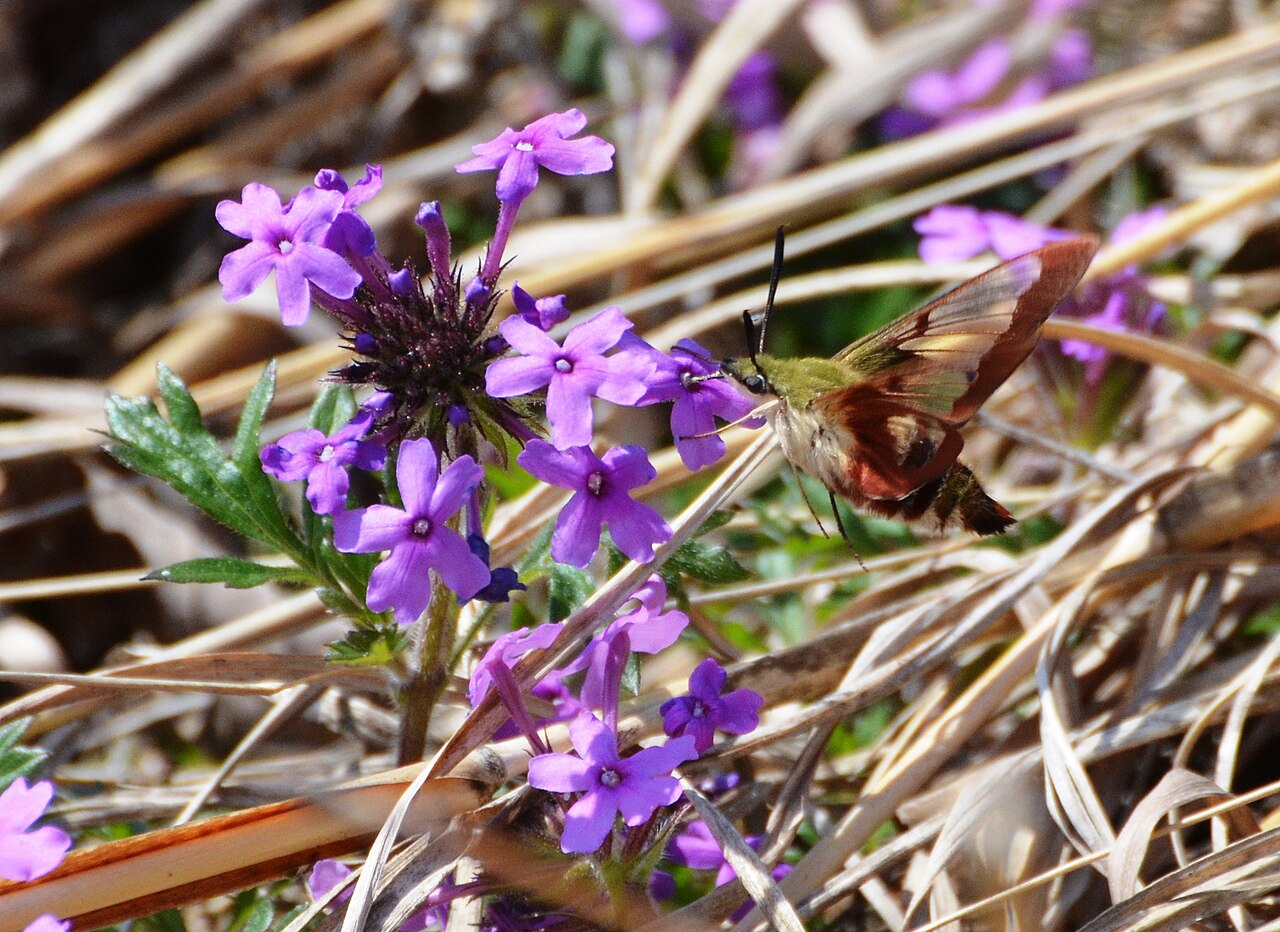
What unites them is the feeding style. They hover in front of a flower rather than landing, unroll a proboscis that in some species exceeds the length of the body, and drink nectar while holding position, adjusting constantly against the breeze. The wingbeat is fast enough to blur and to produce an audible hum, which completes the illusion.
The Species You Are Likely to See
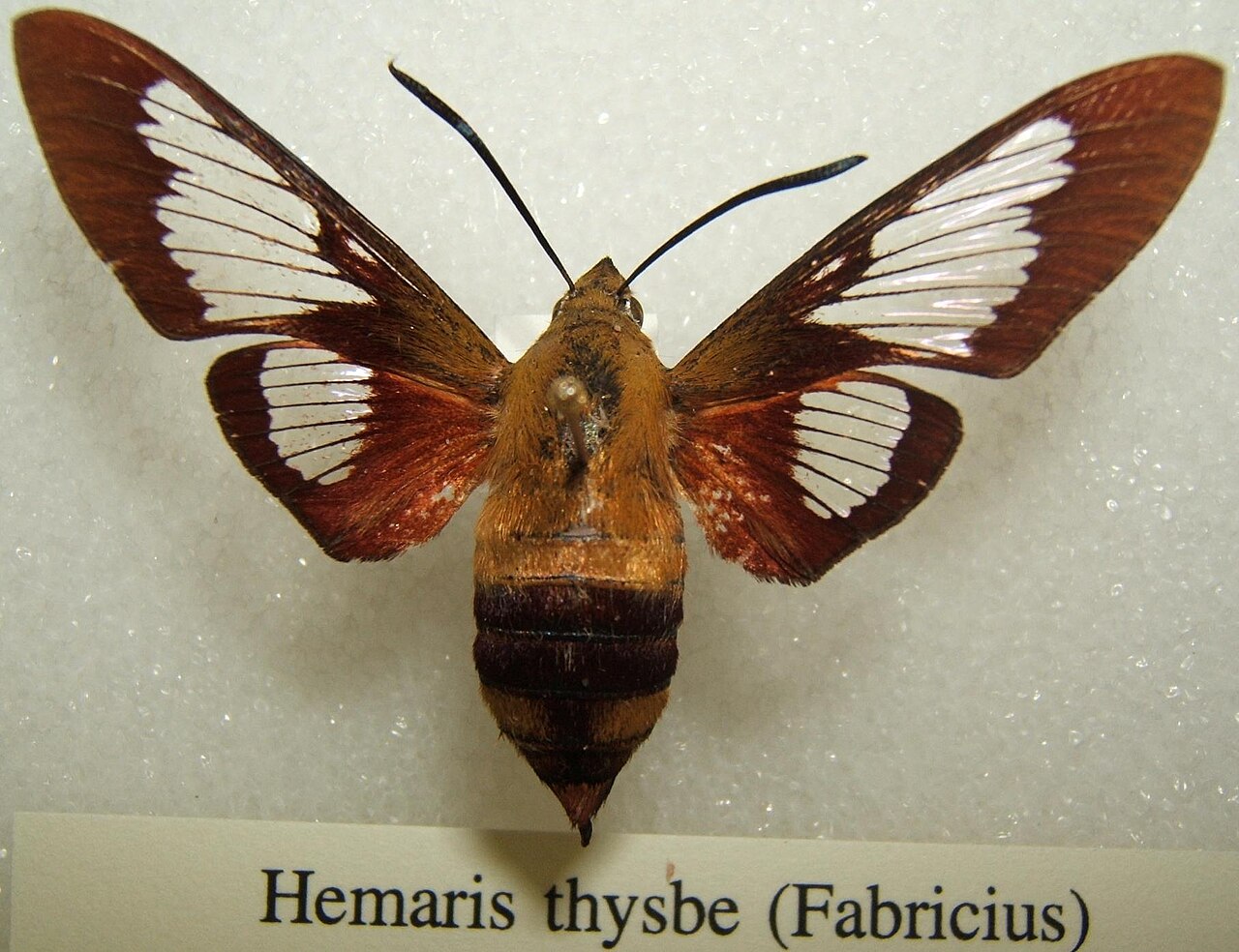
The hummingbird clearwing (Hemaris thysbe) is the most widespread in eastern North America. It has olive to golden-brown upperparts, a burgundy to reddish-brown abdomen, and wings with large transparent panels bordered in reddish-brown, and it reaches 1.5 to 2 in across.
The snowberry clearwing (Hemaris diffinis) overlaps in range and looks strikingly different, with black and yellow banding that makes it a convincing bumblebee mimic, plus a black stripe through the eye. People often report it as a strange bee rather than a moth.
Two more fill out the group. The white-lined sphinx (Hyles lineata) is much larger at 2.5 to 3.5 in with bold white stripes across brown forewings and pink hindwings, flies at dusk, and is common in the west and southwest. The European hummingbird hawk-moth (Macroglossum stellatarum) is orange-brown with a distinctive checkered abdomen, migrates north across Europe each summer, and is the species behind most European sightings.
Hummingbird Moth or Actual Hummingbird?
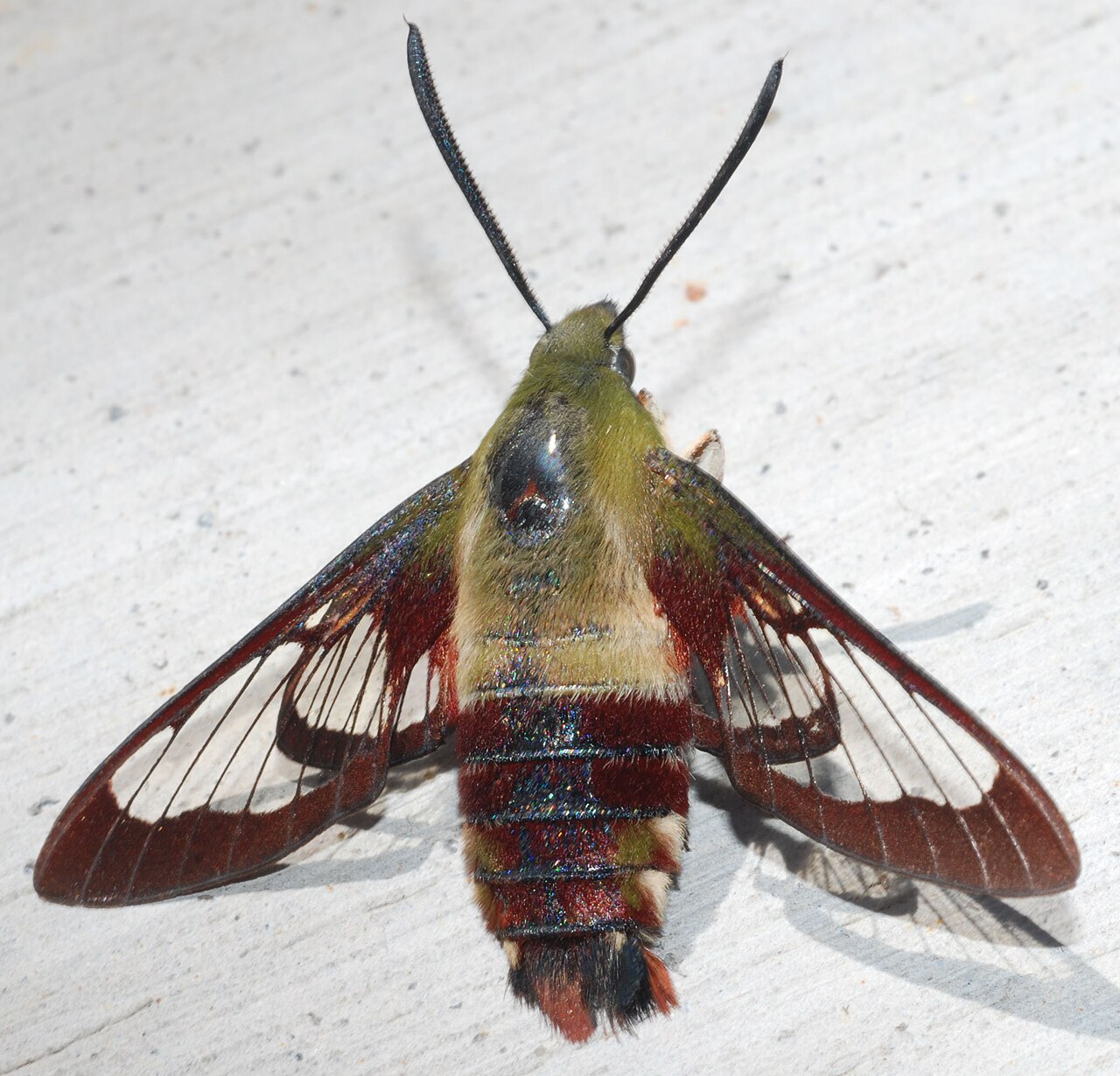
Antennae settle it immediately. Moths have them, birds do not, and on a hovering hummingbird moth the antennae are clearly visible projecting forward from the head. If you can see antennae, it is an insect.
Size and structure back that up. The common clearwings are 1.5 to 2 in long while a ruby-throated hummingbird is 3 to 3.75 in, so the moth is noticeably smaller. A moth has six legs tucked beneath the body, a furry segmented insect body, and a coiled proboscis rather than a rigid bill, and it lacks feathers entirely.
Behavior differs subtly. Moths tend to stay lower among flowers and move between blooms in a more continuous drifting way, while hummingbirds dart, perch frequently, and defend feeders aggressively. Our guide to birds that look like hummingbirds covers the reverse problem, which is real birds mistaken for something else.
Why the Wings Are Transparent
Clearwing moths are not born with clear wings. When the adult emerges from the pupa, the wings are fully covered in scales like any other moth, and the transparency develops within minutes.
The scales are only loosely attached in the areas that will become windows. During the first wingbeats they detach and fall away, leaving the transparent membrane exposed and a dense border of scales around the edge. A freshly emerged clearwing that has not yet flown looks like an ordinary opaque moth.
The likely function is camouflage in flight. Transparent panels break up the outline of a hovering insect against a bright background, and the bee-like banding on the snowberry clearwing adds a second layer of protection through mimicry of an insect that stings. Neither Hemaris species can sting or bite, so both defenses are bluffs.
Hummingbird Moth Caterpillars
The larvae are hornworms, the same body plan as the tomato and tobacco hornworms familiar to vegetable gardeners. They are green or occasionally brown, reach about 1.5 to 2 in, and carry a curved horn at the rear end that looks threatening and is entirely harmless.
Host plants are specific and worth knowing. Hummingbird clearwings feed on honeysuckle, snowberry, viburnum, hawthorn, and cherry, and snowberry clearwings on snowberry, honeysuckle, and dogbane. These are the plants that decide whether the adults stay in your garden or merely pass through.
Damage is negligible in almost every case. Unlike tomato hornworms, which strip a plant fast, clearwing larvae occur in small numbers on shrubs that can easily spare the leaves. If you find a green hornworm on honeysuckle, leaving it produces a pollinator, and our guides to the fuzzy caterpillar and the black caterpillar help identify the other larvae sharing the same shrubs.
Life Cycle and Where They Overwinter
Females lay small round green eggs singly on the underside of host plant leaves, and they hatch within about a week. Caterpillars feed for several weeks, molting as they grow, then drop to the ground when fully fed.
Pupation happens at ground level rather than on the plant. The caterpillar spins a loose cocoon among leaf litter or just under the soil surface, and the pupa overwinters there. This is the detail that matters most for anyone who wants more of these moths, because raking and removing every leaf in autumn takes the next generation with it.
Adults emerge in spring, and in the southern part of the range there are two generations per year, with the second brood flying into early autumn. Adults live a few weeks. Leaving leaf litter in beds and under shrubs through winter costs nothing and protects clearwing pupae along with a great many other insects.
What They Eat and When They Fly
Adults drink nectar and nothing else, using a proboscis that is coiled at rest and extends to reach into tubular flowers. Favored plants include bee balm, phlox, verbena, honeysuckle, lilac, butterfly bush, thistle, and red clover, with a clear preference for flowers that hold nectar deep where short-tongued insects cannot reach it.
Daytime flight is what makes them unusual, and the peak is often mid-morning through late afternoon with a second burst near dusk. Warm sunny days with little wind produce the most activity, which is also when people are most likely to be in the garden watching.
As pollinators they are genuinely valuable. Long-tongued hovering insects reach flowers that bees cannot service, and sphinx moths are the primary pollinators of several native plant species. A garden that hosts them is getting pollination work done that nothing else in the garden performs.
Are Hummingbird Moths Harmful?
No. They have no sting, no bite, no venom, and no capacity to harm a person, and the proboscis is a drinking straw rather than a weapon. Adults are strictly nectar feeders.
The caterpillars cause no meaningful garden damage either. They feed on shrubs rather than vegetables, they occur in small numbers, and the horn that makes them look dangerous is a soft harmless projection. Nothing about the species justifies control measures.
The confusion worth clearing up involves a different group. Clearwing borer moths in the family Sesiidae are wasp mimics with transparent wings whose larvae bore into tree trunks and squash vines, and those are genuine pests. They look superficially similar but are slimmer and more wasp-like, and they do not hover at flowers, which is the giveaway.
How to Attract Hummingbird Moths
Plant the host plants, because this is what determines whether they breed rather than visit. Native honeysuckle, snowberry, viburnum, and hawthorn are the key species for the clearwings, and a single established shrub can support a local population.
Add nectar plants with a long bloom sequence. Bee balm, phlox, verbena, lilac, salvia, and native thistle cover most of the season, and clustering plants in blocks rather than scattering single specimens makes them easier for a hovering insect to work efficiently.
Then stop doing the two things that undo it. Leave leaf litter and unraked beds through winter to protect overwintering pupae, and avoid insecticides entirely, especially neonicotinoids, which persist in plant tissue and are present in nectar and pollen of treated plants. A garden managed this way supports the same insects covered in our guides to the green butterfly and the white moth, and the nectar plants overlap heavily with the recommendations in our guide to attracting hummingbirds.
Related reading: Cecropia Moth.
Related reading: Giant Moth.
Related reading: Luna Moth Meaning.
Frequently Asked Questions
What is a hummingbird moth?
A day-flying sphinx moth that hovers at flowers and drinks nectar through a long proboscis, moving much like a hummingbird. In North America it usually means the hummingbird clearwing or snowberry clearwing, both about 1.5 to 2 in across with partly transparent wings.
How do I tell a hummingbird moth from a hummingbird?
Look for antennae, which moths have and birds do not. Moths are also smaller at 1.5 to 2 in versus 3 to 3.75 in, have six legs and a furry insect body, and feed through a coiled proboscis rather than a rigid bill.
Why are hummingbird moth wings transparent?
The scales are present when the adult emerges but are loosely attached in those areas and fall off during the first flight, leaving clear membrane with a scaled border. A freshly emerged clearwing that has not yet flown looks like an ordinary opaque moth.
Do hummingbird moths sting or bite?
No. They have no sting, bite, or venom, and the proboscis is only for drinking nectar. The caterpillars are harmless too, and the horn on the rear end is a soft projection rather than a stinger.
What do hummingbird moth caterpillars look like?
They are hornworms, green or occasionally brown, about 1.5 to 2 in long with a curved harmless horn at the rear. They feed on honeysuckle, snowberry, viburnum, hawthorn, and cherry, and they cause negligible damage compared with tomato hornworms.
Where do hummingbird moths go in winter?
They overwinter as pupae in loose cocoons among leaf litter or just under the soil surface, not on the plant. Raking and removing all leaves in autumn destroys the next generation, so leaving litter under shrubs through winter matters.
How do I attract hummingbird moths to my garden?
Plant host plants such as native honeysuckle, snowberry, and viburnum so they can breed, add nectar plants including bee balm, phlox, and verbena in blocks, leave leaf litter through winter to protect pupae, and avoid insecticides, especially neonicotinoids.