Yellow Beetle Identification: 6 Common US Species and Which Ones Harm Plants
A yellow beetle in your garden is almost always one of about six common North American species, and none of them can sting you or poison you. The yellow beetles people photograph most often are the golden tortoise beetle, the goldenrod soldier beetle, the spotted cucumber beetle, the American carrion beetle, the swamp milkweed leaf beetle and the locust borer. Each one has a different yellow pattern, a different size and a very different relationship with your plants.
Telling them apart takes seconds once you know what to look at: body shape, whether the yellow is metallic or flat, and how many black spots sit on the wing covers. This guide covers the species you are most likely to find from Maine to California and which of them is worth a second thought indoors.
Yellow beetles in the United States are harmless to people. None sting, none bite hard enough to break skin and none are venomous. The most common are the golden tortoise beetle, goldenrod soldier beetle, spotted cucumber beetle, American carrion beetle, swamp milkweed leaf beetle and locust borer. Only the cucumber beetle and the locust borer damage plants or trees.
| Species | Size | Yellow pattern | Range | Harmful? |
|---|---|---|---|---|
| Golden tortoise beetle | 0.2 in (5 mm) | Metallic gold, domed shell | East of the Rockies | No, minor leaf holes |
| Goldenrod soldier beetle | 0.5 in (12 mm) | Soft yellow with two black blotches | Eastern and central US | No, pollinator |
| Spotted cucumber beetle | 0.25 in (6 mm) | Greenish yellow, 11 black spots | Nationwide | Yes, garden pest |
| American carrion beetle | 0.6 in (15 mm) | Yellow shoulder plate, black body | Eastern US and Canada | No, decomposer |
| Swamp milkweed leaf beetle | 0.4 in (10 mm) | Orange yellow with black blotches | Eastern and central US | No, milkweed only |
| Locust borer | 0.7 in (18 mm) | Bright yellow bands on black | Eastern US | Yes, damages locust trees |
What Are Yellow Beetles?
Yellow beetles are not a family or a group. They are beetles from several unrelated families that happen to carry yellow pigment or a yellow structural sheen on their wing covers. Yellow in insects usually does one of two jobs: it warns predators that the insect tastes bad, or it copies a wasp pattern so that birds leave it alone.
That second strategy is why so many yellow beetles look vaguely dangerous and are not. A locust borer with its black and yellow bands reads as a wasp from two feet away, which is exactly the point. If you want the real thing, compare it with a black and yellow wasp, which has a narrow waist and a visible stinger that no beetle has.
No North American beetle injects venom. Large species can pinch if squeezed and blister beetles irritate skin when crushed, but a yellow beetle on your hand cannot hurt you.
Golden Tortoise Beetle (Charidotella sexpunctata)
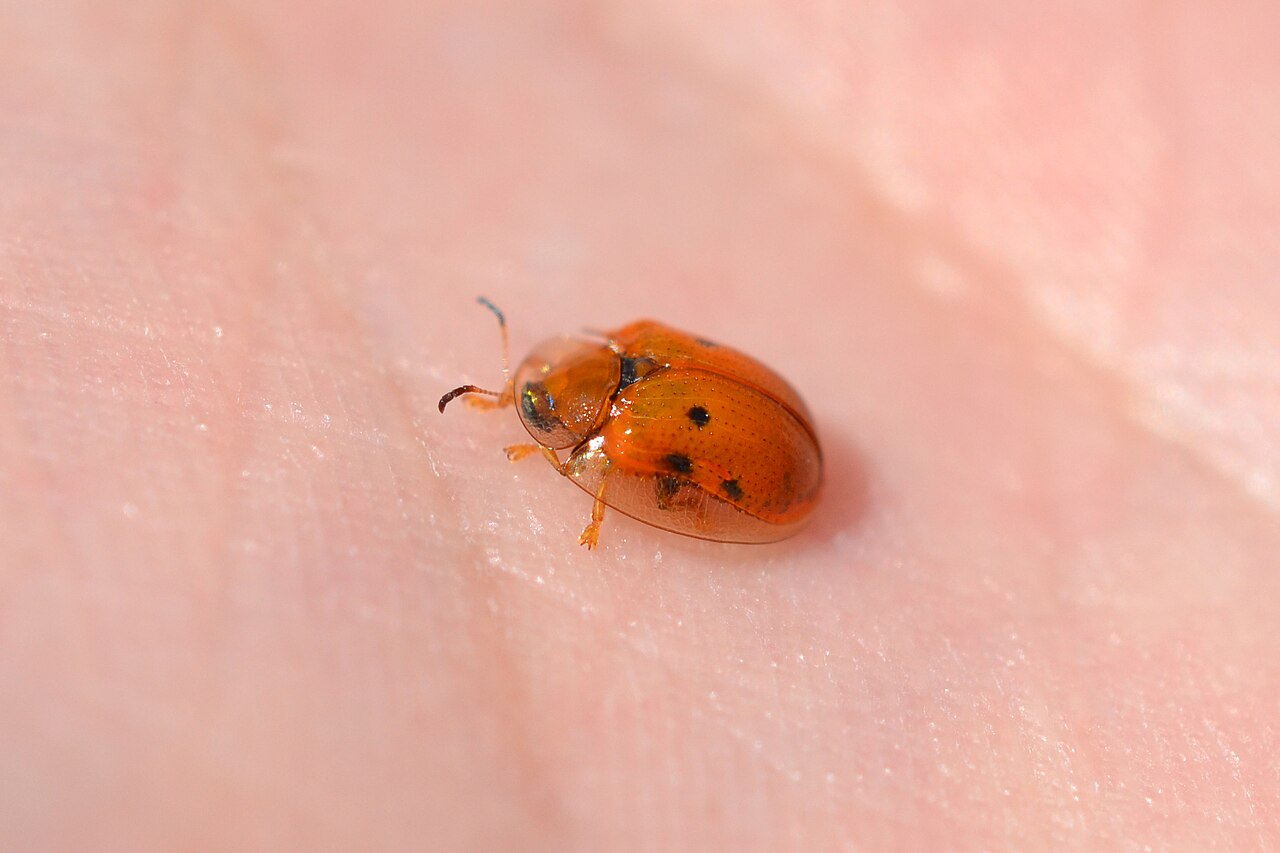
This is the beetle that makes people stop walking. At roughly 0.2 in (5 mm) it looks like a drop of liquid gold with a transparent rim, and it can shift from gold to reddish orange within minutes by changing the moisture in its shell. Bindweed and morning glory are its host plants, and it is common in gardens from Texas to southern Canada.
Golden beetles are not harmful. Adults chew small round holes in leaves and never reach damaging numbers on anything a gardener cares about. Finding one usually means you have bindweed nearby, which is a far bigger problem than the beetle.
What it means when you see a golden beetle is folklore, not biology: in North America a gold beetle reads as a sign of money or luck, much like a pink beetle or a ladybug. Photograph it before the shine dulls.
Goldenrod Soldier Beetle (Chauliognathus pensylvanicus)
If you see dozens of soft bodied yellow beetles crawling over goldenrod in late summer, these are them. They run about 0.5 in (12 mm) long with flat yellow wing covers, each marked with a dark blotch near the tip, and a yellow head with black eyes. Unlike most beetles their wing covers are leathery rather than hard.
Soldier beetles are among the most useful insects in an American garden. Adults move pollen between late season flowers while the larvae hunt grasshopper eggs, aphids and caterpillars in the soil. They do not bite, do not damage plants and vanish with the first hard frost.
Their black and yellow pattern is close enough to a wasp that birds give them room. The same trick shows up all over the yard, from a black and yellow caterpillar to a yellow and black bird using contrast for a completely different reason.
Spotted Cucumber Beetle (Diabrotica undecimpunctata)
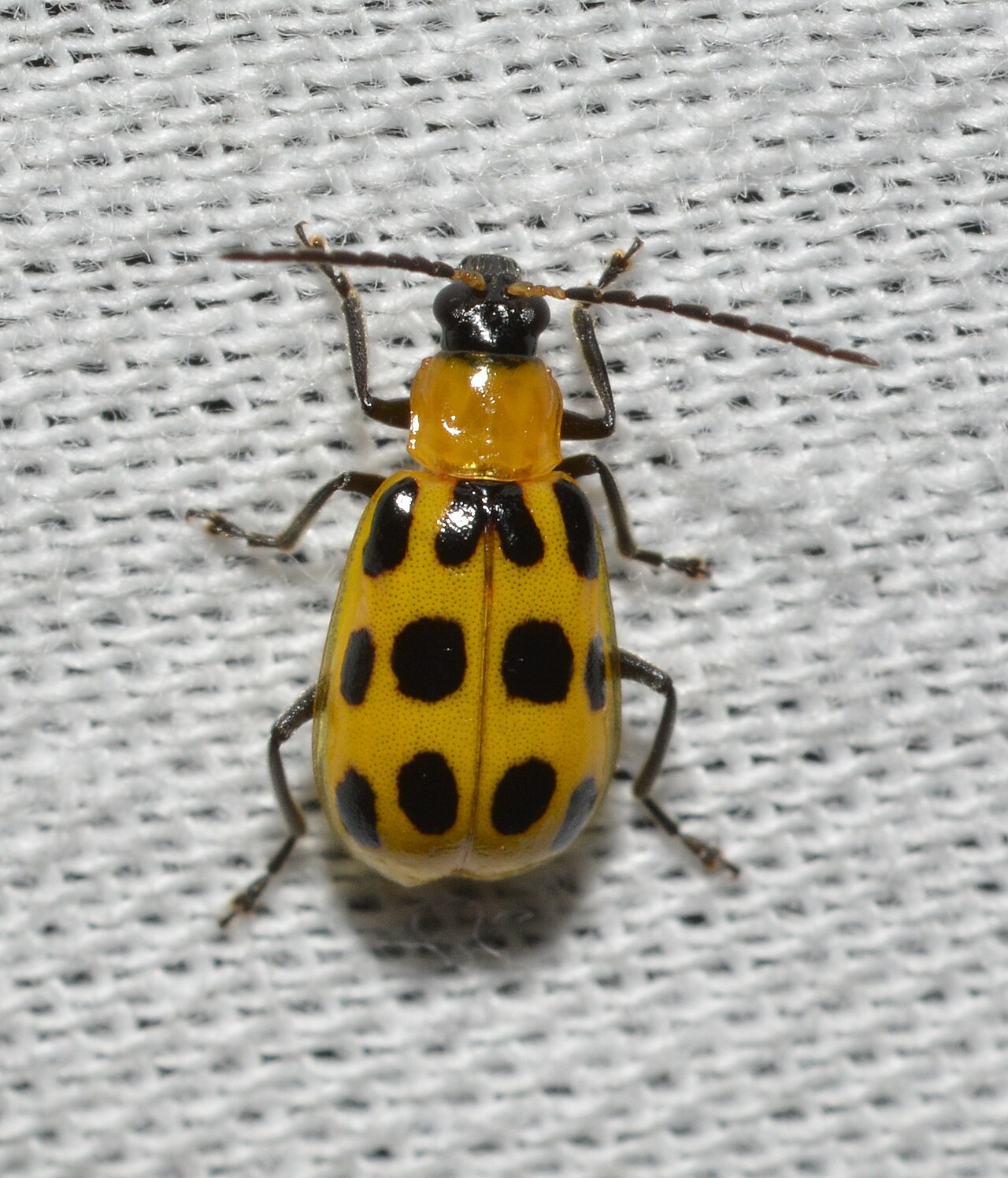
This is the answer to the common question about a beetle that is orange or yellow with black spots. The spotted cucumber beetle is about 0.25 in (6 mm) long, greenish yellow, with 11 clean black spots on its back and a black head. It occurs across the entire country and is the one yellow beetle most likely to cost you vegetables.
Adults chew leaves, flowers and fruit on squash, cucumber, melon and beans, and they carry bacterial wilt and squash mosaic virus from plant to plant. The larvae, known as southern corn rootworms, feed on roots underground. A handful on a mature plant is tolerable; a dozen on seedlings is not.
Row covers until flowering plus hand removal on cool mornings handles most home gardens. Yellow sticky cards work because the beetles are drawn to their own color.
American Carrion Beetle (Necrophila americana)
At 0.6 in (15 mm) with a bright yellow plate behind the head and a black body, this beetle shows up at dead animals, in compost and occasionally at a pet food bowl left outside. People ask whether American carrion beetles are good or bad. They are unambiguously good: both adults and larvae consume carrion and the fly maggots competing for it, which speeds up decomposition and cuts fly numbers.
The only cost is the smell they carry and a tendency to arrive in numbers when something has died under a deck. Remove the carcass and they leave within a day or two. If your beetle is uniformly dark, compare it against a black beetle first.
Swamp Milkweed Leaf Beetle and Locust Borer
The swamp milkweed leaf beetle is a rounded, glossy orange yellow insect about 0.4 in (10 mm) long with irregular black blotches, living almost entirely on milkweed. It is harmless, never reaches pest levels, and its colors advertise the milkweed toxins in its body.
The locust borer is the one yellow beetle with a real economic cost. Roughly 0.7 in (18 mm) long, black with sharp yellow bands including a W shaped mark across the wing covers, it gathers on goldenrod flowers in late summer and lays eggs in the bark of black locust trees. The larvae tunnel into the trunk and weaken or kill young trees. Its longhorn shape separates it quickly from a red and black beetle or a black and white beetle of similar length.
Should I Be Worried if I Find a Beetle in My House?
A single yellow beetle indoors is a wanderer that came in on a window screen or a cut flower. Carry it outside and nothing follows. The species in this guide do not breed in houses, do not feed on wood or fabric and do not bite sleeping people.
Indoor beetles worth real attention are a different group entirely: carpet beetles in wool and stored wool items, and yellow mealworm beetles (Tenebrio molitor) in forgotten grain, flour or birdseed. Both are brown or mottled rather than bright yellow, and both mean you have a food or fiber source to find. For identification keys and species accounts, the Smithsonian Institution maintains public entomology resources covering most North American beetle families.
Frequently Asked Questions
What are yellow beetles?
Yellow beetles are unrelated beetle species that share yellow wing covers. In the United States the common ones are golden tortoise beetles, goldenrod soldier beetles, spotted cucumber beetles, American carrion beetles, swamp milkweed leaf beetles and locust borers. The yellow serves as a warning color or as camouflage that mimics a wasp.
Are golden beetles harmful?
No. The golden tortoise beetle chews small holes in bindweed and morning glory leaves and nothing else. It cannot bite or sting people, it does not enter houses to breed and it causes no measurable damage to vegetables, ornamentals or lawns. Most gardeners never notice its feeding at all.
What kind of beetle is orange with black spots?
Most often the spotted cucumber beetle, a greenish yellow to orange beetle about 0.25 in (6 mm) long with 11 black spots. Ladybugs are also orange with spots but are rounded and domed, while cucumber beetles are longer and flatter with visible antennae about half their body length.
What kind of insect is the yellow spotted ground beetle?
Searches for a yellow spotted ground beetle usually land on one of two insects: the spotted cucumber beetle, which is a leaf beetle rather than a ground beetle, or a tiger beetle with pale markings. True ground beetles in the family Carabidae are mostly glossy black or bronze with few yellow species.
Are American carrion beetles good or bad?
Good. They recycle dead animals, compete with blow fly larvae and reduce the number of flies that reach adulthood. They carry an unpleasant smell and may show up in numbers near a carcass, but they do not damage property, bite people or infest food in the house.