White Moth: Identification, Meaning, and Household Species
A white moth in North America is most often a tiger moth, a fall webworm moth, or a white satin moth, and none of them will harm you. The white moth with black spots that people ask about most is usually a salt marsh moth or a Virginian tiger moth, both common across the continent. The tiny white moths flying out of a closet or a pantry are a completely different problem and belong to two specific pest species.
Moths cannot bite or sting, and the adults of most species cannot even feed. Where caution is warranted is with certain caterpillars, since several white moths produce larvae with irritating hairs. This guide covers how to identify the common white moths, the household pest species, whether any are dangerous, and the symbolism that drives so much of the interest in seeing one.
| Species | Key Feature |
|---|---|
| Virginian tiger moth | Pure white, few black dots, orange abdomen sides |
| Salt marsh moth | White with scattered black spots, yellow-orange hindwings in males |
| Fall webworm moth | White, sometimes spotted, larvae build tent webs on branch tips |
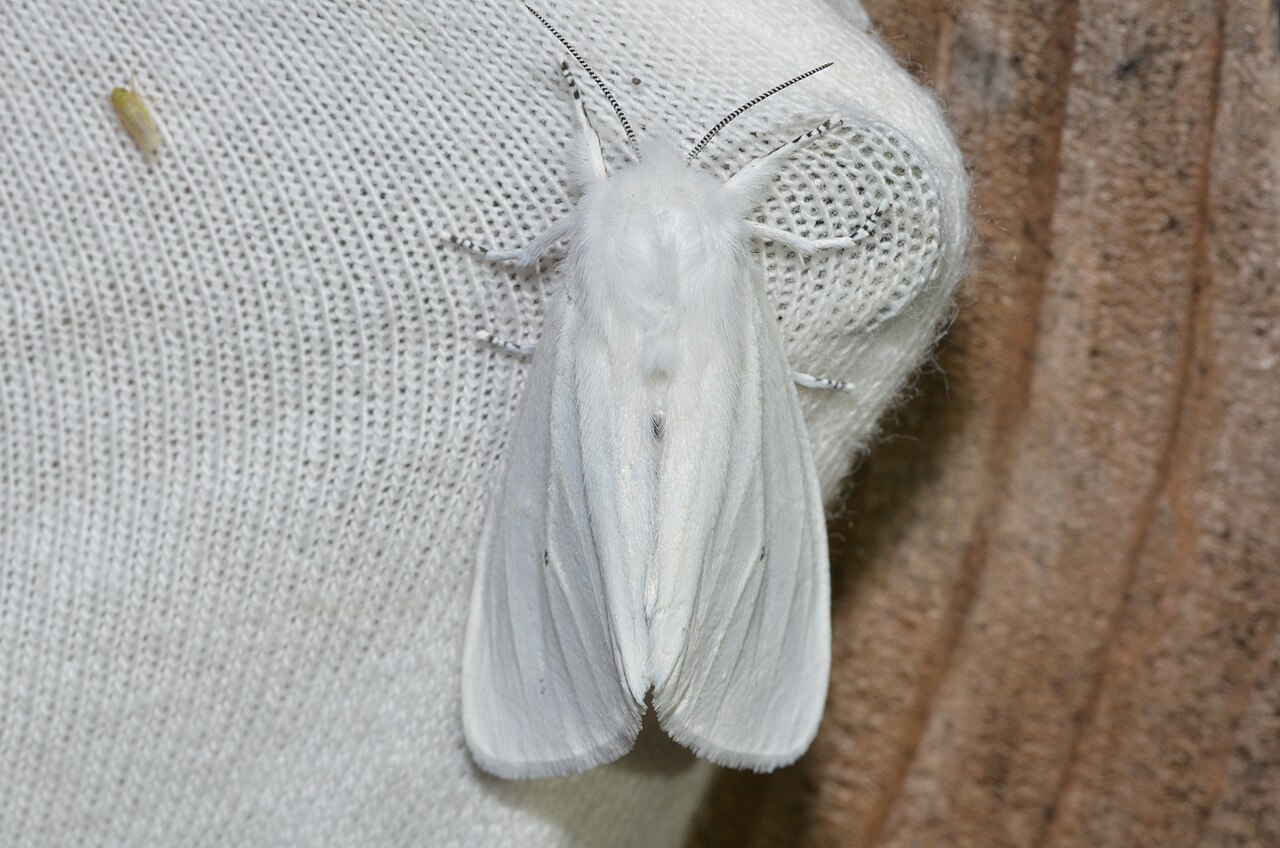
| White satin moth | Glossy satin white, black and white banded legs |
| White plume moth | Feathery divided wings held in a T shape |
| Webbing clothes moth | Tiny, buff-gold, avoids light, damages fabric |
A white moth in North America is usually a tiger moth, a fall webworm moth or a white satin moth, and none are dangerous to people. White moths are not rare; the tiny white moths in a pantry or closet are usually Indian meal moths or clothes moths. Spiritually, a white moth is read as a sign of purity, guidance or a departed loved one.
What Kind of White Moth Did You See?
Size narrows it fastest. A moth with a wingspan above 1.5 in is likely a tiger moth or a satin moth. Anything under about 0.5 in fluttering indoors is almost certainly a clothes moth or a pantry moth, which are pest species rather than garden insects and need a different response entirely.
Then look for spots and the abdomen. Several white species carry scattered black dots, and the pattern and density separate them, while the abdomen often shows orange or yellow markings that are hidden at rest and visible when the moth is disturbed. That flash of color is a warning signal rather than decoration.
Finally note where you found it. Porch lights and windows attract night-flying garden species, closets and wool storage indicate clothes moths, and kitchen cabinets point to pantry moths. Location resolves most identifications before you look at the moth closely at all.
White Moth With Black Spots
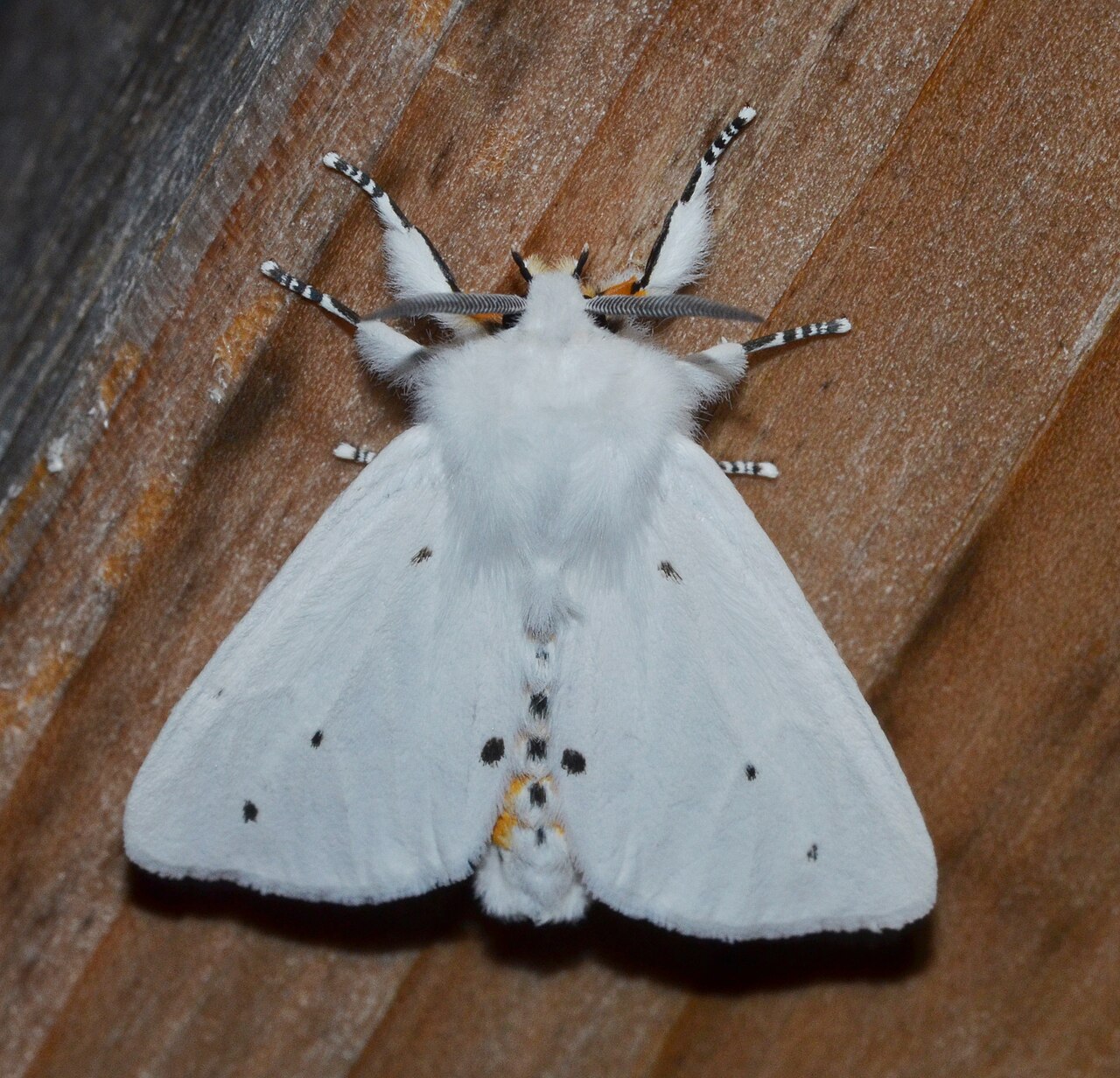
This is the most searched white moth description, and two species account for most sightings. The Virginian tiger moth (Spilosoma virginica) is pure white with a small number of black dots on the wings and body, a wingspan around 1.4 to 2 in, and orange-yellow markings along the sides of the abdomen. It occurs across most of North America.
The salt marsh moth (Estigmene acrea) is similar but more heavily marked, carrying numerous scattered black spots, and males show yellow to orange hindwings while females have white ones. Despite the name it lives far from salt marshes, occurring in fields, gardens, and roadsides continent-wide.
The European white ermine (Spilosoma lubricipeda) fills the same niche in Europe and shows the same white ground with black speckling. All three are tiger moths in the family Erebidae, all are harmless as adults, and all produce hairy caterpillars, which is where the caution belongs. Fuzzy larvae of this kind are covered in our guide to the fuzzy caterpillar.
Fall Webworm and White Satin Moths
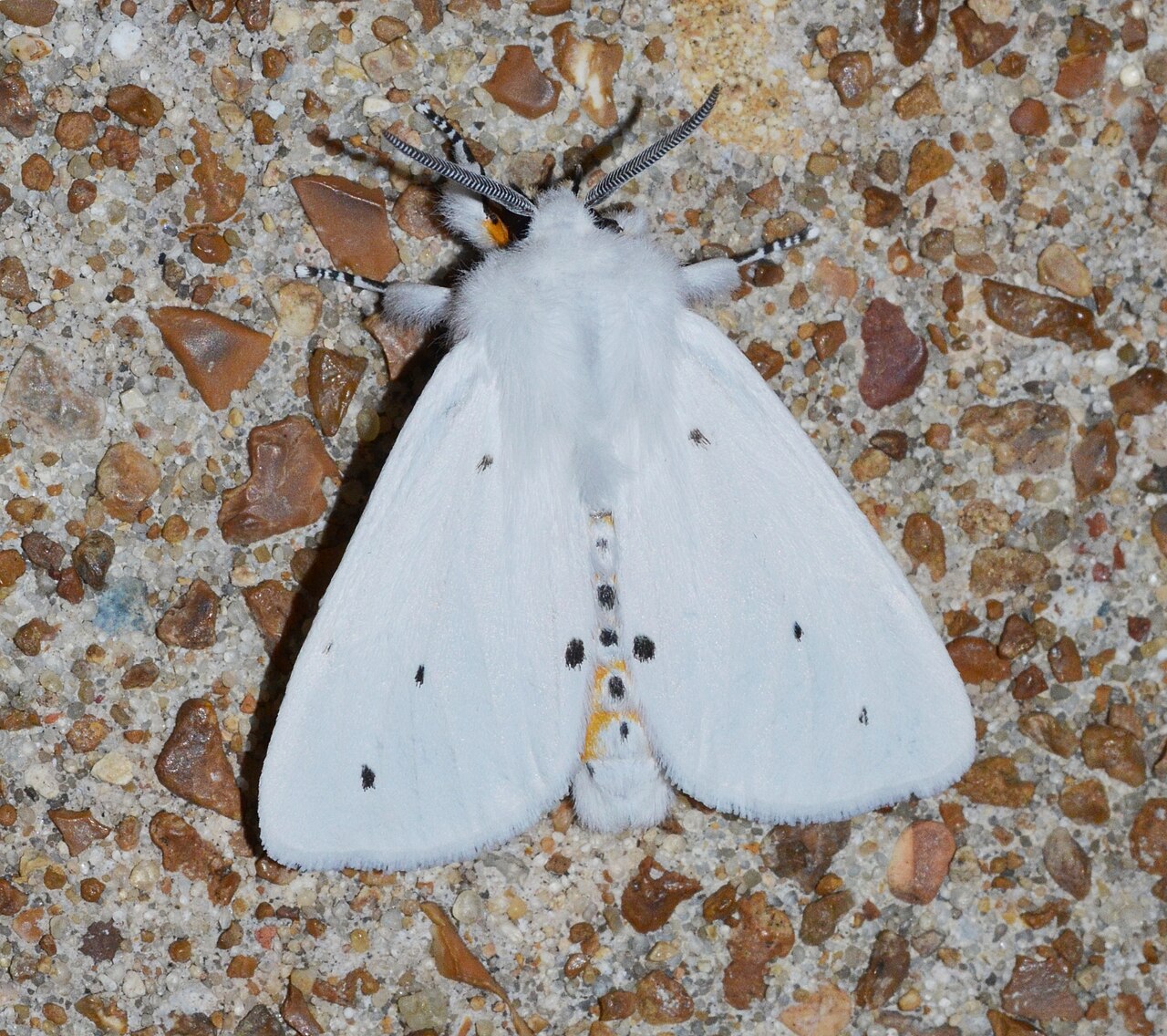
The fall webworm moth (Hyphantria cunea) is one of the most abundant white moths in North America, white or white with dark spots depending on region, with a wingspan around 1 to 1.7 in. Northern populations tend to be plain white and southern ones spotted, which confuses identification across the range.
Its larvae are far more visible than the adults. Fall webworm caterpillars build conspicuous silk tents over the tips of branches in late summer, enclosing leaves and feeding inside, and the webs persist on trees long after the caterpillars have gone. They are unsightly but rarely damage the health of an established tree, and they should not be confused with eastern tent caterpillars, which build in branch forks in spring.
The white satin moth (Leucoma salicis) is a different animal, glossy white with a satin sheen and distinctive black and white banded legs, introduced to North America from Europe in the 1920s. Its caterpillars feed on poplar and willow and can defoliate trees in outbreak years, making it a genuine forestry pest rather than a cosmetic nuisance.
The White Plume Moth
The white plume moth (Pterophorus pentadactyla) looks unlike any other moth and is unmistakable once seen. Its wings are divided into feathery lobes, and at rest it holds them straight out to the sides, producing a narrow T-shaped silhouette that people frequently mistake for a small white insect skeleton or a piece of plant fluff.
It is common in Europe and Asia, with related plume moths found across North America. The wingspan runs about 1 to 1.4 in, and the whole insect is pure white. They are weak, fluttering fliers, often seen at dusk around hedgerows, gardens, and rough grassland where bindweed grows.
The larvae feed on bindweed, which makes the adults a welcome sight for gardeners fighting that particular weed. Plume moths do no damage to garden plants, they do not enter houses in numbers, and they need no management of any kind.
Tiny White Moths in the House
Small pale moths indoors are usually one of two pests, and identifying which one determines the fix. Webbing clothes moths (Tineola bisselliella) are about 0.25 in, buff to golden rather than truly white, and they avoid light, which is why you find them in dark closets and under furniture rather than at windows. The larvae eat wool, cashmere, silk, feathers, and fur, the same materials targeted by the pest in our guide to carpet beetle bites.
Indian meal moths, the standard pantry pest, have distinctly two-toned wings that are pale near the body and coppery beyond the midpoint, so a truly white moth in the kitchen is more likely a white-shouldered house moth. Either way, the larvae infest grains, flour, cereal, dried fruit, nuts, and pet food, and the moths you see flying are the adults that have already bred.
The response is the same in structure for both. Find the source, because the flying adults are a symptom rather than the problem, then discard infested items, vacuum shelves and closet corners thoroughly including cracks, wash or freeze salvageable textiles, and store the rest in sealed containers. Pheromone traps monitor the population and confirm whether the problem is resolved, but they do not eliminate an infestation on their own. Household nuisance insects follow the same source-first logic, as our guide to getting rid of gnats explains.
Are White Moths Harmful?
Adult moths are harmless. They have no sting, no biting mouthparts capable of breaking skin, and many species including the tiger moths cannot feed at all as adults, living only long enough to mate and lay eggs on stored fat reserves. Touching a moth does no harm beyond removing scales from its wings, which does harm the moth.
The caterpillars are where genuine caution applies. Salt marsh, Virginian tiger, and several tussock moth larvae carry dense hairs that can cause contact dermatitis in sensitive people, producing itching, redness, and a rash that lasts a day or two. The reaction is mechanical and allergic rather than venomous, and washing with soap and lifting embedded hairs with tape usually resolves it.
A few unrelated caterpillars are genuinely venomous, including the puss caterpillar and the saddleback, and those produce real pain requiring medical attention. The safe general rule with any fuzzy or spiny caterpillar is not to handle it bare-handed, which costs nothing and eliminates the question. Serious reactions with swelling beyond the contact area or breathing difficulty warrant a call to poison control at 1-800-222-1222 in the United States.
White Moth Meaning and Symbolism
Moths carry heavier symbolism than most insects, and white ones carry the heaviest. Across many cultures a white moth entering a house is read as a message from or about the dead, and in parts of Mexico and Central America moths are associated with departed souls returning. The association is old and widespread.
Other readings are gentler. Because moths transform completely from caterpillar to adult and because they orient toward light, they are frequently interpreted as symbols of transformation, of seeking truth, and of vulnerability. White specifically adds associations of purity, peace, and clarity in most Western symbolic traditions.
The naturalist explanation for the encounter itself is simpler. Moths navigate using distant light sources, and artificial lighting overwhelms that system, drawing them toward porches, windows, and open doors. A white moth in your house means you left a light on near an open window in summer. Both readings can coexist, and neither requires dismissing the other.
Attracting or Discouraging White Moths
To see more of them, plant for the caterpillars rather than the adults. Native trees and shrubs including willow, poplar, birch, and cherry support enormous numbers of moth species, and leaving leaf litter and standing stems over winter protects the pupae that would otherwise be raked away. Night-blooming flowers such as evening primrose and nicotiana feed the adults that do feed.
Moths matter more ecologically than their reputation suggests. They are major pollinators of night-blooming plants, and their caterpillars are the single most important food source for nesting songbirds, with a pair of chickadees requiring thousands of caterpillars to raise one brood. A yard with no caterpillars is a yard that cannot support breeding birds.
To reduce them around the house, address lighting rather than the insects. Warm-toned or amber LED bulbs attract far fewer moths than white or blue-white light, motion sensors cut total exposure, and closing curtains prevents indoor light from spilling out. Insecticide fogging outdoors is counterproductive, killing pollinators and the predatory insects that regulate pest species, much as our guides to getting rid of earwigs and the orchid mantis both illustrate for beneficial insects caught in the crossfire.
Related reading: Cecropia Moth.
Related reading: Giant Moth.
Related reading: Imperial Moth.
Related reading: Luna Moth Meaning.
Related reading: White Moth Meaning.
Related reading: Luna Moth.
Related reading: Brown Moth Identification.
Related reading: Black and White Moth.
Tiny White Moths: Pantry Moth or Clothes Moth?
Small white or pale moths indoors are almost always one of two pests, and where you see them tells you which. A moth flying near the kitchen, especially around cupboards, is an Indian meal moth, roughly half an inch long with a two-tone wing, pale at the base and coppery toward the tip. A moth found in a closet or drifting along a baseboard is usually a webbing clothes moth, smaller, plain straw-colored, and a reluctant flier that prefers to run and hide.
The distinction decides where you look for the source. Pantry moths breed in dry goods, so the larvae are in flour, cereal, rice, nuts, birdseed or dry pet food, often in an unopened bag at the back of a shelf. Clothes moth larvae feed on keratin, which means wool, felt, fur and feathers, usually in a stored garment, a rug edge under furniture or an old wool blanket rather than in anything you wear regularly.
Neither bites or carries disease, and neither is the same insect as the larger white moths outdoors. The Smithsonian’s overview of moths gives the wider context for how varied the group is.
Related reading: Rosy Maple Moth.
Frequently Asked Questions
What is a white moth with black spots?
Most often a Virginian tiger moth, which is pure white with a few black dots and orange along the abdomen sides, or a salt marsh moth, which carries more numerous scattered spots. Both are widespread across North America and both are harmless as adults.
Are white moths dangerous?
Adult moths cannot bite or sting, and many species cannot feed at all. The caution applies to caterpillars, since salt marsh, tiger, and tussock moth larvae carry hairs that cause contact dermatitis in sensitive people. Do not handle fuzzy caterpillars bare-handed.
What are the tiny white moths in my house?
In closets and wool storage, webbing clothes moths, which are about 0.25 in, buff-gold, and avoid light. In the kitchen, pantry moths infesting grains, flour, and dried goods. Find and discard the infested source, vacuum thoroughly, and store the rest in sealed containers.
What does a white moth symbolize?
In many cultures a white moth in the house is associated with messages from the dead or with departed souls, particularly in parts of Mexico and Central America. Gentler readings emphasize transformation, seeking truth, and purity. Practically, moths come indoors because artificial light disrupts their navigation.
What is the moth with feathery wings held in a T shape?
A white plume moth. Its wings are divided into feathery lobes and held straight out at rest, producing a narrow T silhouette often mistaken for plant fluff. The larvae eat bindweed, so the adults are a benefit to gardeners rather than a pest.
Are white moths rare?
No. Fall webworm moths, Virginian tiger moths, and salt marsh moths are among the most abundant moths in North America. They seem uncommon because they fly at night and most people only notice them at porch lights.
Should I remove fall webworm webs from my trees?
Usually not. Fall webworm webs appear at branch tips in late summer, look unsightly, and rarely harm an established tree. Pruning out the affected tips is enough if appearance matters. Insecticide is counterproductive because it kills the parasitic wasps that control the population naturally.