Baby Rat Snake: Identification and Why It Looks So Different
A baby rat snake looks so different from its parents that it is one of the most misidentified reptiles in America: hatchlings emerge 10 to 16 inches long wearing a pale gray body with bold dark blotches down the back, a pattern that reads “dangerous” to worried homeowners even though the adult will grow into a plain black, yellow, or gray snake depending on region. That juvenile blotch pattern is the engine behind thousands of “is this a copperhead or rattlesnake?” posts every August and September, when the year’s hatchlings disperse into garages, gardens, and basements.
The short answer worth front-loading: baby rat snakes are nonvenomous, harmless to people and pets, and among the most beneficial animals that will ever cross your property, each one a future 5-foot rodent-removal machine. This guide covers how to identify a hatchling at a glance, the copperhead and rattlesnake separations that end the panic, the growth timeline from egg to adult, and what to do with the one currently behind your water heater.
| Fact | Baby Rat Snake |
|---|---|
| Hatchling size | 10 to 16 inches |
| Pattern | Gray with dark squarish blotches |
| Hatch season | Late July to September |
| Clutch size | 10 to 20+ eggs |
| Venomous? | No, completely harmless |
| Adult size | 3 to 6 feet, plain-colored |
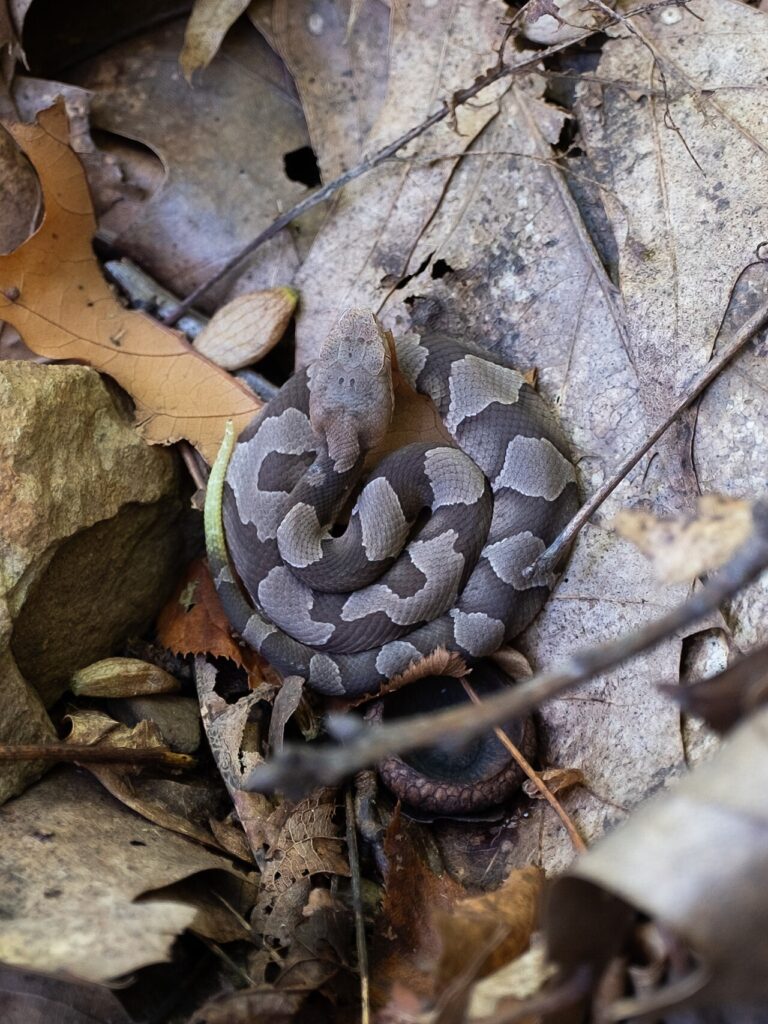
A baby rat snake is gray or light brown with dark squarish blotches down its back, a checkered black-and-white belly and round pupils, looking nothing like the plain adult. A baby copperhead has hourglass-shaped bands, a bright yellow-green tail tip and vertical pupils. Square saddles mean rat snake, hourglasses mean copperhead.
Why Baby Rat Snakes Look Nothing Like Adults
Rat snakes undergo one of the most dramatic color transformations in North American reptiles. Every hatchling, regardless of region, starts with the same uniform: a light gray to brownish base marked with dark gray-brown blotches, squarish saddles down the spine with smaller side blotches, a boldly patterned head, and often a dark stripe through the eye. The adult destination varies by geography: solid glossy black across the Northeast and Midwest, yellow with stripes along the Southeast coast, gray “oak snake” pattern in parts of the Gulf South, but the babies are near-identical everywhere.
The mismatch has a working theory: juvenile blotches are camouflage for a snake small enough to be eaten by hawks, herons, kingsnakes, and even large frogs, breaking up the body outline against leaf litter, while adults, too big for most predators, trade concealment for the thermoregulation and durability of darker, plainer scales. The pattern fades gradually, ghost blotches often remain faintly visible on subadults in good light, and full adult coloring settles in around 2 to 3 years.
For identification, that means one crucial mental adjustment: you cannot match a baby to the adult rat snakes you know from your area. The plain black snake in your barn and the blotchy gray baby in your flowerbed are the same species at different chapters, and our full rat snake guide shows both ends of the transformation, with the regional yellow and gray forms like the Texas rat snake covered in their own profiles.
Baby Rat Snake vs Copperhead: Ending the Panic
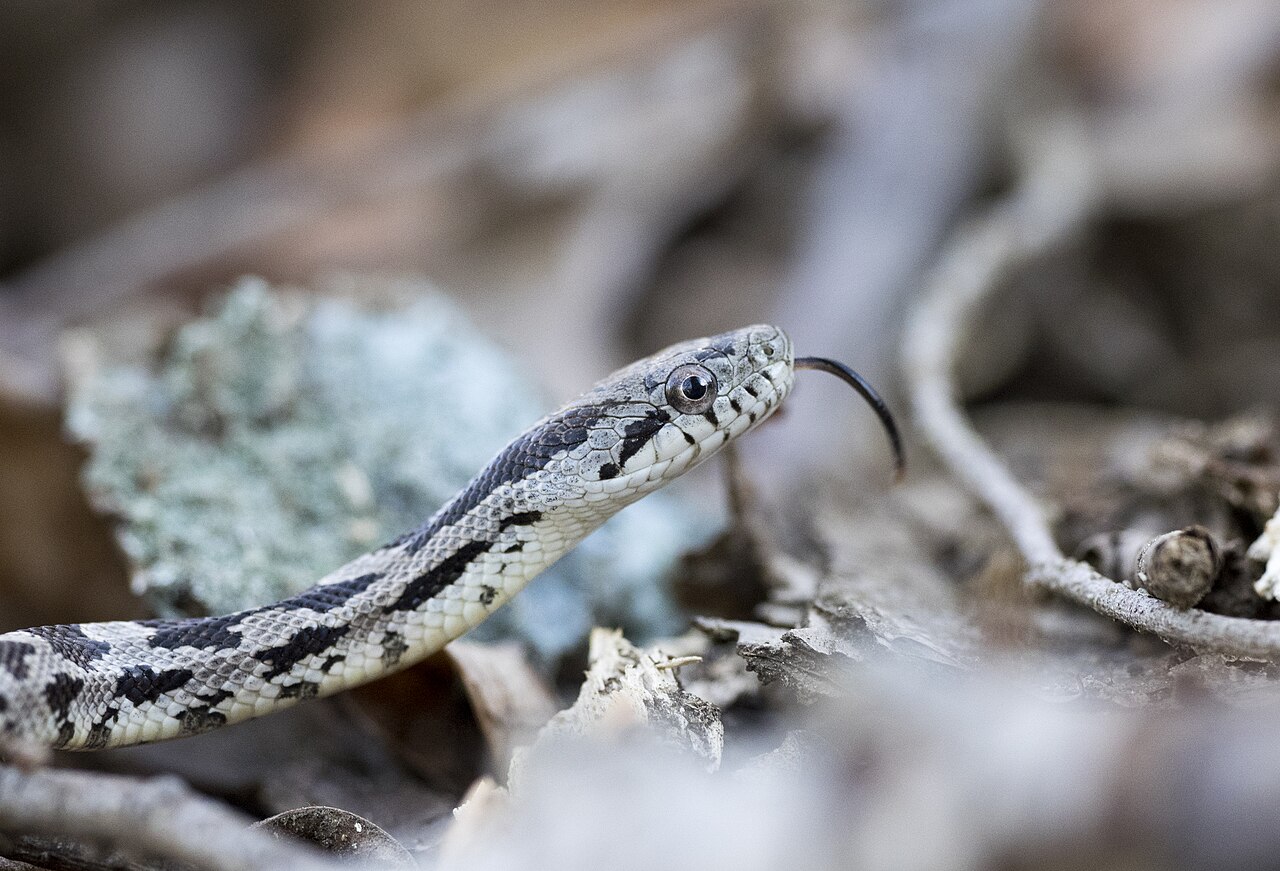
This is the identification that matters most, and three features settle it in seconds. First, pattern shape: copperhead crossbands are hourglasses, wide on the sides, pinched narrow across the spine, while baby rat snake blotches are the opposite, widest across the back, like squarish saddles. Look at the spine: pinched means copperhead, blocky means rat snake.
Second, color and texture: copperheads run copper, tan, and pinkish-brown with an unmarked coppery head, and newborns carry a famous sulfur-yellow tail tip they twitch as a lure; baby rat snakes are gray-scale, with a patterned head and no yellow tail. Third, build and behavior: copperheads are thick-bodied, keeled-scaled ambushers that hold their ground, while baby rat snakes are slender, quick, and openly flee, climb, or vibrate their tails in dry leaves when cornered.
The tail-vibration habit deserves its own line because it fools people in the other direction: a cornered baby rat snake buzzing its tail against leaves produces a convincing rattle sound with no rattle attached. A glance at the tail ends it, no segmented rattle, no rattlesnake, and the genuinely venomous baby that does carry equipment is covered in our baby rattlesnake guide for the side-by-side. When any doubt remains, the universal rule applies: photograph from distance, touch nothing.
From Egg to Hatchling: The Rat Snake Nursery
Rat snakes are egg-layers on a summer schedule. Females mate in spring and deposit 10 to 20 or more leathery, oblong eggs in June or July, choosing warm, humid, hidden incubators: rotting logs and stumps, mulch and compost piles, sawdust heaps, and the occasional raised garden bed, then leave; there is no parental care in this species. Warmth does the work, and after roughly 60 to 75 days the clutch hatches from late July into September.
Hatchlings slit their eggshells with a temporary egg tooth and emerge fully operational: 10 to 16 inches of independent predator with the same climbing skill, constricting technique, and rodent obsession as the adults, minus only the size. They disperse from the nest site within days, which is why late summer produces the sudden wave of blotchy juveniles in yards; the eggs were incubating in that mulch pile all along.
Gardeners meet the eggs occasionally, white to cream ovals about 1.5 to 2 inches long, often adhered in a cluster, in compost or under landscape timbers. The neighborly move is to re-cover them where found; a hatched clutch converts to a season of free rodent patrol, and the papery slit-open shells you might find in fall are the only bill you will ever receive.
Growth Timeline: Blotchy Baby to Barn Legend
A hatchling that survives its first year grows fast on a rodent economy: roughly 12 inches of growth annually in good habitat for the first few years, with the juvenile pattern dimming as length accumulates. By age 2 to 3 a rat snake runs 3 feet and wears most of its adult color; sexual maturity arrives around 3 to 4 years, and growth continues slowly for life toward the 4 to 6 foot adults that make rat snakes among the longest snakes in North America.
The first year is the filter. Hatchlings feed on the small end of the menu, lizards, frogs, and nestling rodents, while serving as prey themselves for hawks, owls, kingsnakes, raccoons, and cats, and only a fraction reach their first birthday, the standard reptile arithmetic behind those 20-egg clutches. Survivors inherit a long tenure: wild rat snakes commonly live 10 to 15 years.
Along the way they develop the party trick that names the family’s reputation: climbing. Even hatchlings ascend bark and brick with ease, and juveniles turn up in shrubs, on window screens, and famously inside wren and bluebird boxes, the one genuine conflict rat snakes have with bird-loving households, solved by stovepipe or cone baffles under nest boxes rather than by anything done to the snake.
What Baby Rat Snakes Eat (and What Eats Them)
Hatchling rat snakes start on prey scaled to a pencil-thick predator: small lizards (fence lizards, skinks, anoles in the South), tree frogs, and pinkie-stage rodents raided from nests, all killed by constriction like the adults do it. The rodent share of the diet grows with the snake, and by the 2-foot mark a juvenile is running the full mouse-vole-rat portfolio that makes the species agriculture’s favorite reptile.
The menu placement cuts both ways at baby size. Hatchlings are on the shopping list of red-tailed and red-shouldered hawks, owls, herons, kingsnakes (enthusiastic snake-eaters), raccoons, opossums, and free-roaming cats, which is why babies spend their time under cover, in leaf litter, mulch, woodpiles, and stone gaps, and why most human encounters are accidental unveilings during yard work.
Reading snake sign fills in the picture between sightings: shed skins snagged on brick or lumber (a hatchling shed is a delicate 12-inch ghost, complete with eye caps), and droppings with fur and bone that our snake poop guide distinguishes from lizard and rodent sign. A shed plus vanishing mouse activity is the classic evidence that your property has hired help.
Found One in the House or Garage: The Calm Playbook
Baby rat snakes enter buildings for the same reason mice do, gaps, and often literally following mice: a hatchling fits through a crack of about a quarter inch, and garages, basements, and crawl spaces in August are the classic venues. The animal is harmless, cannot meaningfully bite through skin even if it tries, and wants out as much as you want it out.
The two-minute eviction: place an empty trash can or bucket on its side ahead of the snake and herd it gently in with a broom, then carry it out and release at the yard edge near cover; or trap it under a bucket, slide cardboard beneath, and ferry the package outside. Gloves if you like, though a baby rat snake’s defensive repertoire, musk, tail buzz, mock strikes, is theater without consequence.
Then close the door it used: seal foundation cracks and gaps around pipes with mortar or steel wool backing, fix door sweeps, and screen weep holes and vents, the same quarter-inch audit that excludes mice, which is fitting since indoor snakes are usually a symptom of indoor rodents. Glue traps deserve a specific warning: they catch and slowly kill the harmless snake sent to solve your actual problem, and a snake stuck to one can be freed with a gentle pour of vegetable oil before outdoor release.
Why a Baby Rat Snake Is a Yard Upgrade
Run the math on what hatches from one clutch: each surviving rat snake grows into a predator that removes dozens of rodents per year for a decade or more, working the exact spaces, wall voids, woodpiles, barns, burrow systems, that traps and cats miss, with no poison entering the food chain. State wildlife agencies uniformly class rat snakes as beneficial, and the Virginia DWR (dwr.virginia.gov) notes rat snakes are among the most economically valuable snakes in the state for rodent control.
The rodent connection also runs the tick-and-disease angle: fewer mice means fewer hosts for the larval ticks behind Lyme disease and less rodent-borne contamination in sheds and coops, an ecosystem service delivered silently and for free. A property that hosts rat snakes typically also hosts fewer of everything people actually call exterminators about.
Legal status backs the ecology: rat snakes are protected from killing in several states, and there is no scenario where killing one improves anything anyway; vacant snake habitat refills from next door. Tolerance plus targeted exclusion, baffles on the bluebird boxes, hardware cloth on the coop, sealed foundation gaps, keeps every genuine conflict solved while the blotchy hatchling in your mulch grows into the best barn cat you never had to feed. What other harmless lookalikes share the yard, from the milk snake to the tiny baby snakes of a dozen species, is a comparison worth learning once and enjoying for life.
Related reading: Baby Black Snake.
Related reading: Baby King Snake.
Related reading: Baby Corn Snake.
Related reading: Baby Cottonmouth Snake.
Related reading: Baby Ring-Neck Snake.
Related reading: Baby Copperhead Snake.
Related reading: Baby Garter Snake.
Related reading: Baby Hognose Snake.
Related reading: Baby DeKay’s Brown Snake.
Related reading: Baby Gopher Snake.
Do Baby Rat Snakes Bite?
A baby rat snake can bite, but it is not a medical concern. Rat snakes are non-venomous constrictors, and a hatchling has teeth measured in fractions of a millimeter. A defensive bite from one typically produces a few pinprick scratches that stop bleeding on their own and need nothing more than soap, water and an adhesive bandage.
Hatchlings are more willing to strike than adults, which surprises people who expect the baby to be the calmer animal. A 12-inch snake has no other defense, so it will flatten its head into a triangle, vibrate its tail against dry leaves, rear into an S-shape and strike at anything that looms over it. All three of those behaviors get it mistaken for a venomous species, and none of them change the fact that it is harmless.
The practical response is to leave it alone or move it with a broom and a bin rather than by hand. Penn State Extension’s overview of snakes around the home covers safe removal and the exclusion steps that keep them out of garages and basements.
Frequently Asked Questions
What does a baby rat snake look like?
A 10 to 16 inch snake in pale gray with dark squarish blotches down the spine, a patterned head, and often an eye stripe, dramatically different from the plain black, yellow, or gray adult it will become.
Are baby rat snakes venomous or dangerous?
No. They are nonvenomous constrictors, harmless to people and pets, and a hatchling’s bite cannot meaningfully break skin. Their defenses are bluff: musk, tail buzzing, and mock strikes.
How do I tell a baby rat snake from a copperhead?
Check the spine: rat snake blotches are widest across the back (saddles), copperhead bands are pinched narrow there (hourglasses). Copperheads are also coppery with plain heads and a yellow tail tip; rat snake babies are gray with patterned heads.
Why is a baby rat snake shaking its tail like a rattlesnake?
Tail vibration is a bluff many harmless snakes use; in dry leaves it mimics a rattle. A look at the tail tip settles it: no segmented rattle means no rattlesnake.
When do baby rat snakes hatch?
Late July through September, from clutches of 10 to 20+ eggs laid in early summer in rotting wood, mulch, and compost. That timing is why blotchy juveniles suddenly appear everywhere in late summer.
What should I do with a baby rat snake in my garage?
Herd it into a bucket with a broom and release it at the yard edge, then seal the quarter-inch gaps it entered through. It is harmless, and its presence usually signals the mice it followed inside.
How big do baby rat snakes get?
About a foot of growth per year early on, reaching 3 feet and adult coloring by age 2 to 3, and ultimately 4 to 6 feet, making rat snakes among North America’s longest snakes, with wild lifespans of 10 to 15 years.