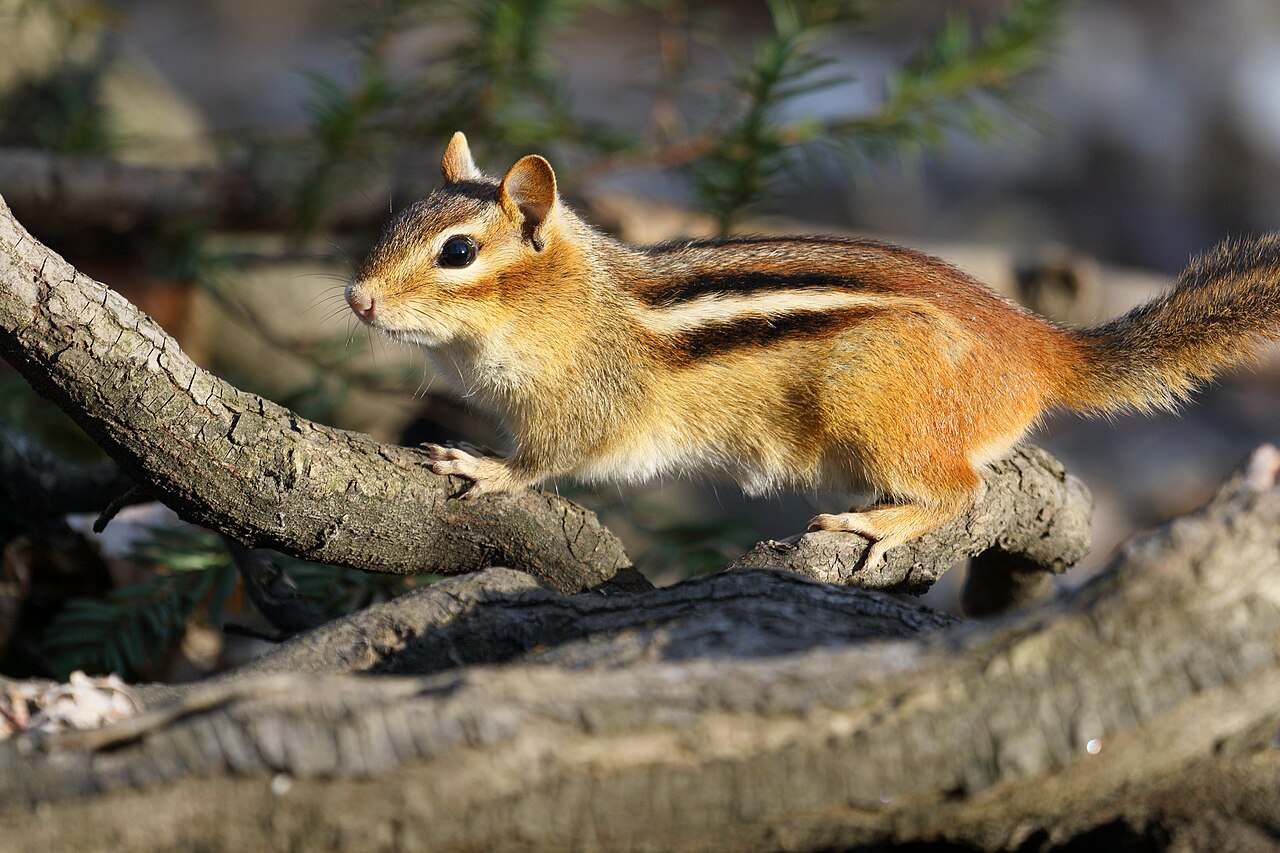
Chipmunk Sounds: What the Chip, Chuck, and Trill Mean
Chipmunk sounds fall into three core calls: a high-pitched “chip,” a lower “chuck,” and a rapid trill given while running for cover. Each one carries a specific message. The chip is an alarm for aerial predators like hawks, the chuck warns of ground predators like cats and foxes, and the trill is a startled escape call that tells nearby chipmunks danger is actively in motion. What surprises most people is the persistence: a single chipmunk can repeat its chip call more than a hundred times per minute and keep it up for half an hour straight.
This guide decodes what each chipmunk sound means, why the chip is so often mistaken for a bird, what fighting and mating chatter sounds like, and why the noise you hear at night is almost certainly not a chipmunk at all. Once you can tell a chip from a chuck, you can read the small dramas of your backyard in real time.
| The “chip” | High-pitched alarm, warns of hawks and aerial threats |
| The “chuck” | Lower clucking alarm, warns of ground predators |
| The trill | Rapid chatter while fleeing, sounds like a squeaky toy |
| Repetition | Often 100+ calls per minute, up to 30 minutes |
| Active hours | Strictly daytime, most vocal in morning and late afternoon |
| Night sounds | Almost never a chipmunk (they sleep underground) |
The Three Core Chipmunk Sounds
Eastern chipmunks, the species in most American backyards, work with a small but precise vocabulary. The chip is the sound everyone has heard: a sharp, high, birdlike note around 3 to 10 kHz, repeated in long, metronome-steady series. The chuck is the chip’s low counterpart, a throatier clucking note that carries a shorter distance. The trill is different in structure, a burst of 3 to 7 rapid notes squeezed into a fraction of a second, almost always given on the run.
The consistency is what makes these calls readable. A chipping chipmunk typically sits bolt upright on a stump, rock, or burrow mound, tail flicking with each note, and holds its post like a sentry. A chucking chipmunk does the same but sounds like a distant knocking or a soft frog. A trilling chipmunk is a brown streak disappearing under your porch. Learn those three pictures and the soundtrack of your yard sorts itself into messages.
There are quieter sounds in the repertoire too. Chipmunks exchange soft squeaks and murmurs at close range during courtship, mothers and pups communicate in faint peeps inside the burrow, and cornered animals hiss and squeal. But the chip, the chuck, and the trill do the heavy lifting, and they are the three you will actually hear from a deck chair.
What Each Chipmunk Sound Means
Decades of field research have shown that chipmunk alarm calls are not generic panic; they are roughly sorted by threat type. Researchers at McGill University who studied eastern chipmunk alarm calling found that chips are strongly associated with aerial predators and chucks with terrestrial ones. In plain terms: a chipping chipmunk has likely spotted a hawk, while a chucking chipmunk is tracking a cat, fox, or human walking through its territory.
The trill has a third job. It is given almost exclusively by a chipmunk that has been startled into flight, and it works like a shouted “danger, moving, here!” to every relative within earshot. Because chipmunks live in loose neighborhoods of related females, warning the neighbors carries a real evolutionary payoff. Field studies have found that chipmunks trill more readily when close relatives live nearby, which is exactly what you would expect from a call that mainly benefits family.
There is also meaning in the rhythm. Slow, steady chipping from a fixed perch signals a threat that is present but not attacking, the rodent equivalent of a neighborhood watch announcement. The series accelerates as the threat closes distance and cuts off entirely when the chipmunk dives for its burrow. If a yard full of chipping suddenly goes silent, the hawk usually just committed.
The “Chip”: The Alarm That Sounds Like a Bird
The single most common identification mistake with chipmunk sounds is calling the chip a bird. It is an honest error: the note is pure, high, and repeated with the mechanical regularity of a cardinal or titmouse chip note, and the caller is usually hidden low in cover where nobody looks for a bird. Birders joke that the eastern chipmunk is the most misidentified “bird” in North America, and apps that identify birds by sound regularly get fooled the same way.
The tell is the rhythm and the endurance. Songbird chip notes come in irregular clusters, mixed with movement and other calls, and rarely continue for long from one spot. A chipmunk chips like a dripping faucet: the same note, the same interval, sometimes twice per second, going on for 10, 20, even 30 minutes from exactly the same place. No backyard bird holds a single perch and a single note that long.
Location helps too. Chips come from stone walls, woodpiles, stumps, and the ground line of brushy edges, not treetops. If you triangulate the sound and find it stubbornly at knee height, you have a rodent, not a warbler. Compare it with the calls in our guide to squirrel sounds, and the family resemblance is obvious: chipmunks are small squirrels, and the chip is a compressed, higher version of the gray squirrel’s barking alarm.
The “Chuck”: The Ground Predator Warning
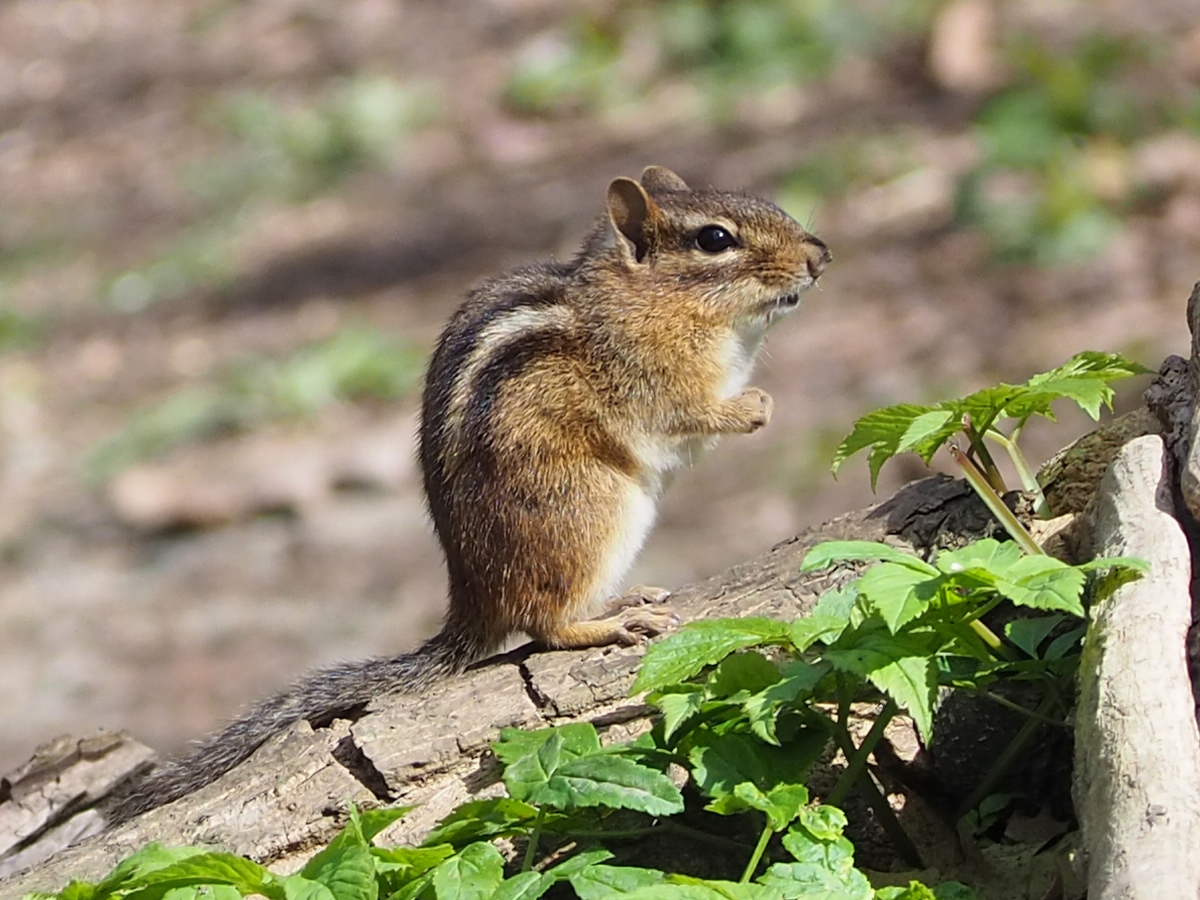
The chuck is the chip’s underappreciated sibling, and many homeowners hear it for years without connecting it to a chipmunk. It is a low, hollow “chuck-chuck-chuck,” sometimes described as a distant woodpecker knocking, a frog, or even a dripping pipe. Because it sits so much lower than the chip, around 1 to 3 kHz, it carries differently through vegetation and is harder to pin to a source.
Functionally, the chuck skews toward ground threats. A fox trotting a field edge, a cat working the shrub line, a human with a leaf blower: all classic chuck triggers. The logic of the lower pitch is practical acoustics. Low frequencies travel better through dense understory where ground predators move, while the high chip cuts cleanly through open air where a hawk hunts. The chipmunk effectively broadcasts on the channel its audience needs.
Chucking sessions can be marathon events, and neighboring chipmunks often join in, producing an eerie, arrhythmic chorus from several directions at once. If your yard erupts in low chucking every evening, take a slow look for the cause; a regular predator is usually on patrol. It is also worth checking what is being left behind: our fox sounds and raccoon sounds guides cover the two nighttime visitors that most often keep daytime chipmunks on high alert.
Chipmunk Sounds at Night: Probably Not a Chipmunk
Here is the myth this article most needs to bust: chipmunks do not call at night. Eastern chipmunks are strictly diurnal. At dusk they retreat into burrow systems up to 3 ft deep and 30 ft long, plug themselves into a sleeping chamber, and stay there until morning. A rodent-like chirp, chatter, or scream after dark is coming from something else, and the something else list is long.
The usual nighttime suspects sort by sound. Rhythmic chirping from trees on warm nights is overwhelmingly insects, crickets and katydids, which people routinely mistake for rodents. Birdlike chips and peents after dark can be flying squirrels, which are common, nocturnal, and squeaky, or night-migrating birds overhead. Screams, whistles, and chatter close to the ground point to raccoons, foxes, or opossums. And scratching or squeaking inside walls at night is classic mouse or rat behavior, not a chipmunk, which will be in its outdoor burrow.
This matters practically. Homeowners who hear night noises and assume “chipmunk in the wall” often trap and treat for the wrong animal. Daytime chipping outside plus nighttime scratching inside means two different animals, and the indoor one deserves the attention. Start diagnosis with the calendar and the clock: chipmunk vocal activity peaks on calm, sunny mornings and late afternoons, roughly March through October, and drops to near zero in winter, when they are mostly underground living off cached seeds.
Fighting, Chasing, and Territorial Chatter
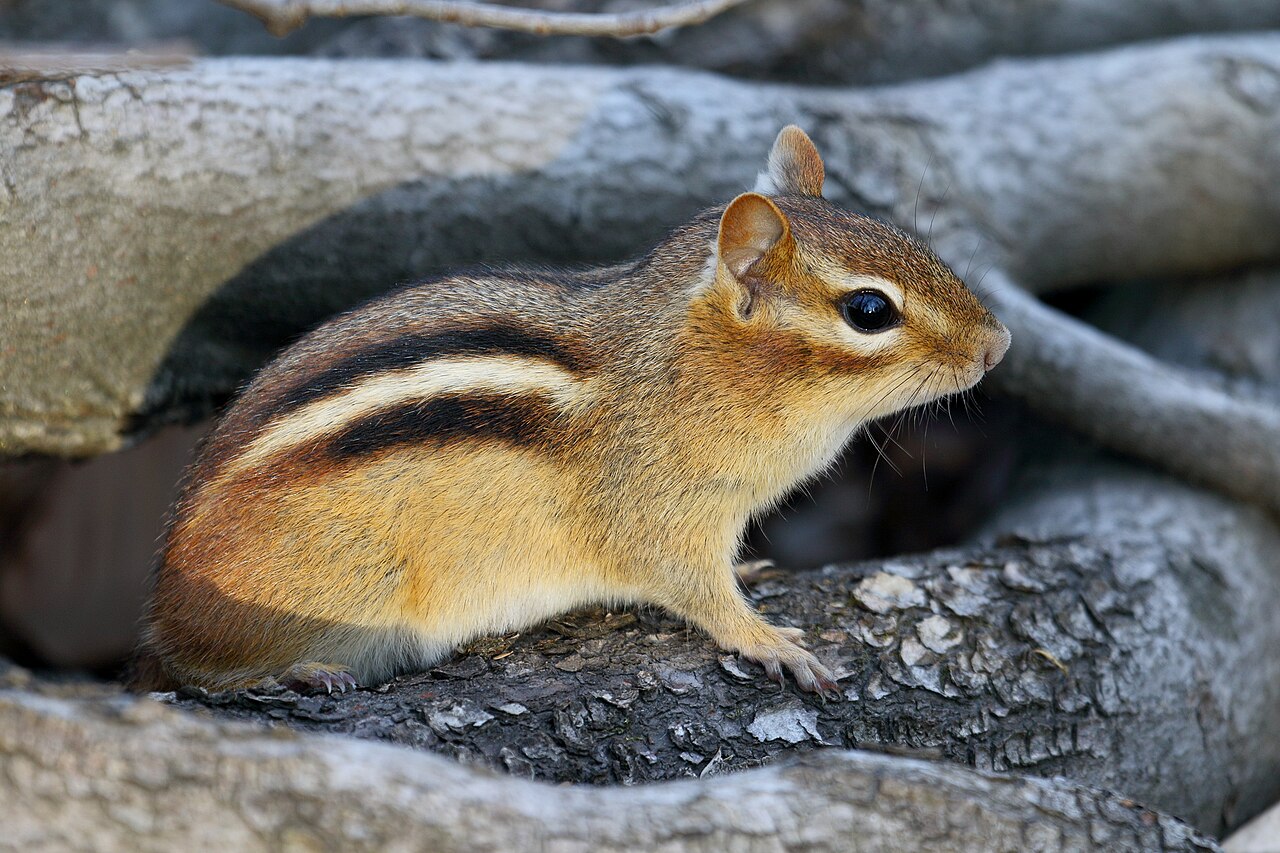
Chipmunks are solitary and territorial, and their disputes are loud. A territorial chase comes with a soundtrack of sputtering chatter, rapid squeaks, and harsh trills as the resident runs an intruder off its 0.25 to 1 acre home range. The sounds are messier than alarm calls: irregular, overlapping, and moving fast across the yard, often accompanied by two brown streaks spiraling around a tree trunk.
Real fights, which are rarer than chases, add squeals and high-pitched shrieks. Spring and late summer are the peak seasons, when males invade territories seeking mates and when the year’s young disperse to claim ground of their own. If your yard sounds like a tiny riot for a week in April, that is the mating season economy at work, males chasing females and each other with almost no dignity intact.
Feeding competition triggers the same vocabulary in miniature. A chipmunk defending a seed spill under a feeder will chatter and sputter at rivals between cheek-pouch loads. It rarely escalates, because the loser can usually just wait; a chipmunk hauling seeds to its cache makes a round trip every few minutes, leaving the buffet open. You can read who owns which corner of the yard just by tracking who chatters and who retreats, and confirm territory lines by where you find their chipmunk poop and cache diggings.
Baby Chipmunk Sounds and Calls for Help
Baby chipmunks are born blind, hairless, and quiet by necessity, but they are not silent. Inside the burrow, pups produce faint, high-pitched peeps and squeaks, especially when hungry or chilled, that carry only within the nest chamber. Around 4 to 5 weeks old their voices strengthen into audible chirps, and by the time they emerge above ground at 6 weeks they can already produce a thin version of the adult chip.
A pup separated from the burrow gives distress calls: repeated, high, thin squeaks that people describe as a squeaky wheel or a bird in trouble. This is the “chipmunk calling for help” that homeowners occasionally hear from a window well, garage, or downspout, all classic traps for dispersing juveniles. A healthy stray pup calling from a hazard can usually be released beside the nearest burrow entrance; the mother retrieves wanderers. Our baby chipmunk guide covers when a young one actually needs a rehabilitator.
Adults have distress vocalizations too. A chipmunk grabbed by a predator or caught in netting produces a piercing, continuous squeal that is unmistakably an emergency, entirely unlike the measured chip of an alarm sentry. And mothers with dependent young are the most vocal chipmunks of all, chipping longer and at greater personal risk than other adults, which matches the family-warning logic of the whole alarm system.
Chipmunk vs Squirrel Sounds: Telling Them Apart
Chipmunks and gray squirrels share the same yards and the same basic call logic, alarm barks and chatter, so confusion is natural. Pitch is the first separator. Chipmunk calls sit noticeably higher and cleaner; a chip is a pure tick of sound. Gray squirrel barks are raspier and buzzier, a “kuk kuk kuk” with a growly quality no chipmunk can produce, often stretched into a wheezing “quaa” that sounds vaguely like a complaining cat.
Delivery differs just as much. Squirrels call mostly from tree trunks and branches, pumping their tails in big waves, and their alarm sessions wander in pitch and rhythm. Chipmunks call from the ground line at machine-gun regularity. As a rule of thumb that holds up well: high, dry, metronomic ticking from low cover is a chipmunk, while rasping and fussing from up a tree is a squirrel. Red squirrels complicate things with their long rattling trill, but that trill runs for seconds continuously, unlike the chipmunk’s short burst.
It is worth a minute to learn the other lookalike sounds in the neighborhood, because the backyard chorus is full of impostors. A distant deer blow can pass for a giant chuck, and a startled skunk produces squeals in the same register as a chipmunk fight. According to the Smithsonian’s National Museum of Natural History, the eastern chipmunk’s chipping rate can exceed 130 calls per minute, a pace no squirrel sustains, so when in doubt, count. Ten identical notes in five seconds from one spot settles it.
Frequently Asked Questions
Why does a chipmunk keep chirping for so long?
Long, steady chipping is sentry behavior: a predator, often a hawk or a cat, is visible but not attacking, and the chipmunk broadcasts its location to relatives until the threat leaves. Sessions of 20 to 30 minutes at over 100 calls per minute are normal.
Do chipmunks make noise at night?
No. Chipmunks are strictly diurnal and spend nights sealed in underground burrows. Night chirping is usually crickets or katydids, flying squirrels, or birds, and scratching in walls at night points to mice or rats instead.
What does it mean when a chipmunk trills?
The trill is a startled escape call, given while the chipmunk runs for cover. It warns nearby relatives that danger is actively in motion, and studies show chipmunks trill more when close kin live within earshot.
Why do chipmunk sounds get mistaken for birds?
The chip is a pure, high note repeated with birdlike regularity, and the caller hides low in cover. The giveaway is endurance and rhythm: one identical note, twice per second, from one fixed spot, sometimes for half an hour.
Do chipmunks scream?
A chipmunk caught by a predator or badly cornered produces a piercing, continuous squeal, and fights include sharp shrieks. These emergency sounds are dramatically different from the measured chip and chuck alarms.
What is the difference between the chip and the chuck?
Both are alarms, but research links the high chip mainly to aerial predators like hawks and the low chuck mainly to ground predators like foxes and cats. Pitch matches purpose: high notes cut through open air, low notes travel through brush.
What do baby chipmunk sounds mean?
Nest pups peep softly when hungry or cold. A lone juvenile squeaking repeatedly from a window well or garage is giving a distress call; placed near the burrow entrance, it is usually retrieved by its mother.