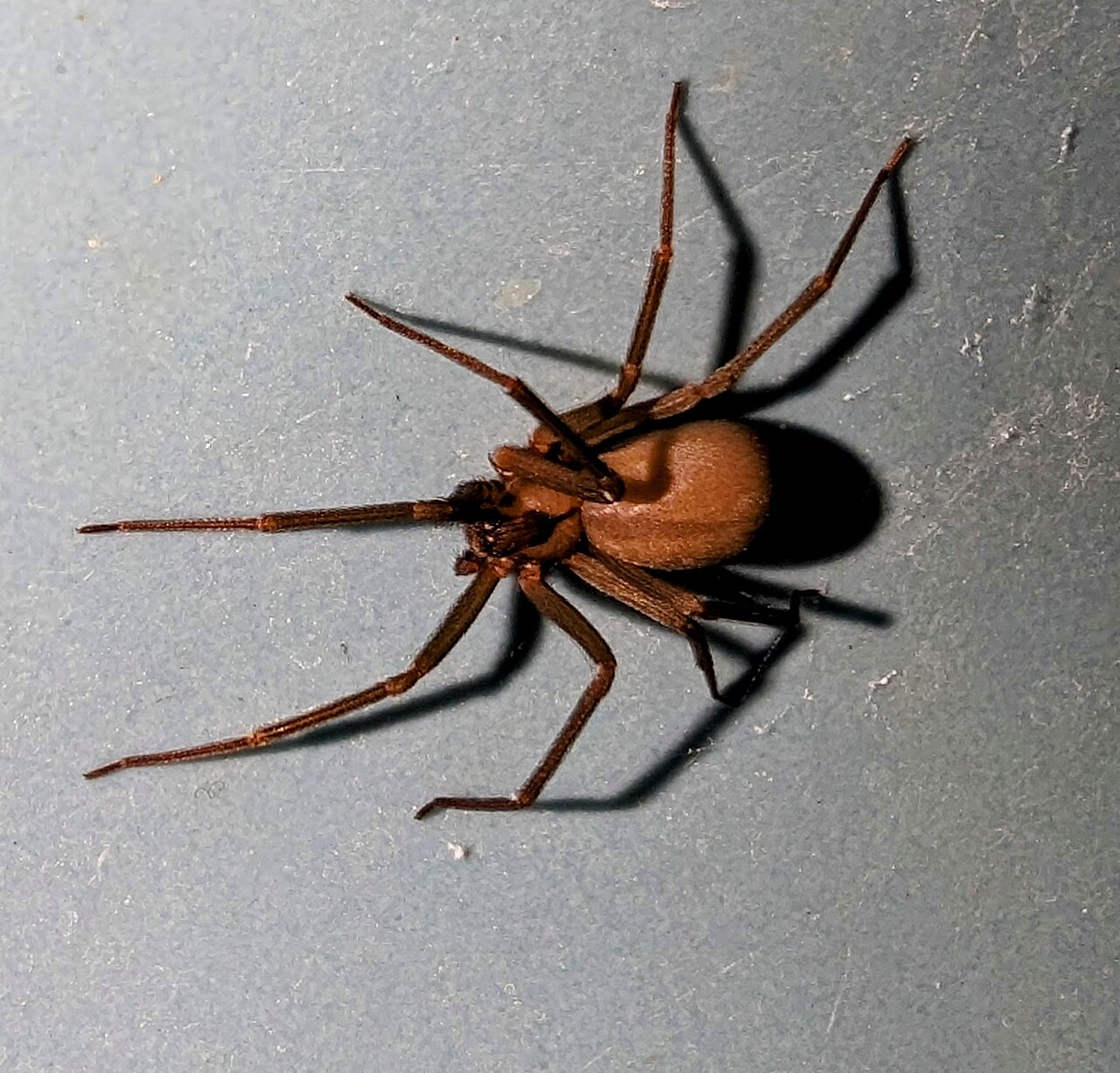
Brown Recluse vs House Spider
The fastest way to tell a brown recluse from a common house spider is to count the eyes and check the web: a brown recluse has six eyes arranged in three pairs and does not build a web to catch prey, while a house spider has eight eyes and spins the messy, funnel-like webs you typically see tucked into ceiling corners and window frames.
Both spiders can be tan to brown and roughly similar in size at a glance, which is exactly why so many harmless house spiders get misidentified as the far more feared brown recluse. Knowing a few reliable identification points, rather than relying on color alone, makes it much easier to tell which one you are actually looking at.
| Quick Reference | Brown Recluse | House Spider |
|---|---|---|
| Scientific Name | Loxosceles reclusa | Genus Parasteatoda (common house spider) |
| Eyes | 6, arranged in 3 pairs | 8, arranged in 2 rows |
| Size | 0.25 to 0.75 inch body | 0.2 to 0.4 inch body, legs up to 3 inches |
| Web | None used for hunting; wanders instead | Messy, funnel-shaped web in corners |
| Bite Risk | Medically significant, though rare | Harmless to people |
Brown Recluse vs. House Spider: The Fastest Way to Tell Them Apart
Eye count is the single most reliable identification feature, though it requires a very close look: a brown recluse has just six eyes, arranged in three widely spaced pairs, while nearly all common house spiders have the standard eight eyes most people associate with spiders in general. This detail is hard to check safely on a live, moving spider, which is why behavioral and habitat clues usually matter more in everyday identification.
The violin-shaped marking often used to identify a brown recluse can be faint, smudged, or entirely absent on some individuals, so relying on that mark alone leads to frequent misidentification in both directions. A far more consistent clue is the web: brown recluses do not spin an organized web to trap prey and instead wander at night hunting on foot, while house spiders build visible, somewhat disorganized funnel or cobwebs in corners, window frames, and other stationary spots, not unlike the webs built by a grass spider outdoors.
Body shape offers one more clue. Brown recluses tend to have a slim body with long, thin, relatively smooth legs, while many common house spiders appear a bit bulkier or fuzzier, with visible patterning across the abdomen that a brown recluse typically lacks. Homeowners trying to identify any small, fast-moving spider in the house often find it helpful to also learn the look of other common backyard arachnids, such as the jumping spider and the banana spider, simply to rule those species out first.
What Does a Brown Recluse Actually Look Like?
Adult brown recluse spiders, Loxosceles reclusa, are roughly the size of a quarter including their leg span, with a body typically between a quarter inch and three quarters of an inch long. Coloring ranges from light tan to dark brown, and many, though not all, show a darker violin-shaped mark on the cephalothorax pointing toward the rear of the body.
Their legs are long, thin, and mostly free of obvious spines or heavy hair, giving the overall spider a delicate, almost fragile appearance compared to bulkier hunting spiders like wolf spiders. Because coloring and markings vary so much between individuals, entomologists often need to examine a specimen under magnification to confirm identification with real confidence.
What Does a Common House Spider Look Like?
Common house spiders, most often species in the genus Parasteatoda, are small, usually measuring somewhere between a fifth and two fifths of an inch in body length, with a leg span that can reach up to about three inches on a mature female. Coloring tends toward yellowish brown or gray, typically with a mottled, irregular pattern across the rounded abdomen rather than the more uniform tone seen on a brown recluse.
Unlike the brown recluse, house spiders are web builders through and through, constructing the tangled, funnel-shaped webs most people picture when they think of a classic spiderweb in an undisturbed corner, basement window, or garage ceiling. These spiders tend to stay close to their web rather than wandering the way a brown recluse does, which makes web presence a genuinely useful clue during identification.
Where Do Brown Recluse Spiders Actually Live?
Contrary to popular belief, brown recluse spiders are not found throughout the United States. Researchers at the University of California, Riverside map the species’ established range to a fairly well-defined zone covering roughly the south-central and lower Midwest, stretching from southeastern Nebraska and Iowa down through Texas and east to Georgia and Ohio, with the densest populations concentrated in Missouri, Kansas, Oklahoma, Arkansas, Tennessee, and Kentucky.
Outside that core zone, confirmed sightings are genuinely rare, and most reported “brown recluse bites” in states like New York, California, or the Pacific Northwest turn out to be misidentified house spiders or another harmless species entirely. An individual spider can hitch a ride into a non-native state inside moving boxes or shipped goods, but these accidental transplants rarely survive long enough to establish an actual breeding population outside the established range.
Within their native range, brown recluses favor quiet, undisturbed indoor spaces such as closets, attics, basements, and storage boxes, along with outdoor shelters like woodpiles, loose bark, and the space under rocks and debris.
Is a Brown Recluse Bite Actually Dangerous?
Brown recluse venom is genuinely medically significant, though bites are far less common than public fear suggests, since the spider is shy, nocturnal, and typically bites only when trapped directly against skin, such as inside a shoe or bedding. Most bites cause localized redness, swelling, and itching that resolve without serious complications, symptoms that can initially look similar to bed bug bites or a mild allergic reaction before the full picture becomes clear.
In a smaller number of cases, the venom can cause the surrounding tissue to break down, producing an open wound that heals slowly and sometimes leaves a scar, and in rare severe cases a bite can trigger systemic symptoms such as fever, nausea, or blood-related complications that require prompt medical attention. Because early symptoms can look like other insect bites or skin infections, doctors sometimes misdiagnose a genuine brown recluse bite, which is part of why any bite that worsens rather than improves over a few days deserves medical evaluation, especially within the spider’s established range. Keeping a photo of the spider responsible, if it can be safely captured, gives a treating physician far more to work with than a description alone.
Are House Spiders Actually Harmless?
Common house spiders pose essentially no danger to people or pets. While any spider can technically bite in self-defense if handled roughly, house spider bites are rare, mild, and typically cause nothing more than brief, minor irritation similar to a small insect bite.
In fact, house spiders quietly do homeowners a favor by catching flies, mosquitoes, and other small nuisance insects in their webs, functioning as a low-effort form of natural pest control in garages, basements, and other quiet corners of a home. Most people never notice a house spider at all unless they happen to spot its web.
How to Prevent Both Spiders From Moving In
Sealing gaps around doors, windows, utility penetrations, and foundation cracks reduces entry points for both brown recluses and house spiders, since both species are drawn indoors while following prey or searching for shelter from temperature extremes. Reducing indoor clutter, particularly in basements, closets, garages, and storage boxes, removes the quiet, undisturbed hiding spots both spiders prefer, the same kind of clutter that also tends to shelter pests like the potato bug.
Outdoors, moving woodpiles, leaf litter, and debris away from the foundation, along with trimming vegetation back from exterior walls, cuts down on the shelter and insect prey that draw spiders toward a house in the first place. For homes within the brown recluse’s established range, shaking out stored shoes, gloves, and bedding before use is a simple, effective habit that avoids the accidental contact that leads to most bites. Reducing the overall insect population around a home, the actual food source for both spiders, also indirectly reduces how attractive a property is to either species in the long run.
When to Call a Pest Professional
Because misidentification is so common, and because a genuine brown recluse bite can occasionally become medically serious, it is reasonable to call a pest control professional for a proper identification any time you find repeated spider activity, egg sacs, or a specimen you cannot confidently identify yourself. This is especially worth doing for households within the brown recluse’s established range in the south-central and lower Midwest United States.
A professional inspection can also uncover the underlying conditions, such as gaps, excess moisture, or an active insect food source, that are drawing spiders indoors in the first place, allowing for a longer-term fix rather than repeatedly removing individual spiders as they appear.
Related reading: House Centipede.
Related reading: Southern House Spider.
Related reading: Black House Spider.
Related reading: Wolf Spider vs Brown Recluse.
Related reading: Brown Ladybug.
Related reading: Red House Spider.
Related reading: Brown Caterpillar.
Related reading: Brown Moth Identification.
Related reading: House Earwig.
Frequently Asked Questions
How many eyes does a brown recluse have compared to a house spider?
A brown recluse has six eyes arranged in three pairs, while a common house spider has the more typical eight eyes arranged in two rows.
Does a brown recluse always have a violin-shaped marking?
No, the marking can be faint, smudged, or barely visible on some individuals, so it should never be used as the only identification feature.
Do house spiders bite people?
Bites are rare and, when they do happen, are harmless, typically causing only brief, minor irritation similar to a small insect bite.
Are brown recluse spiders found all over the United States?
No, their established range is largely limited to the south-central and lower Midwest, and confirmed sightings well outside that zone are genuinely rare.
What should I do if I think I was bitten by a brown recluse?
Clean the area, keep an eye on it over the following days, and seek medical attention if the wound worsens, spreads, or you develop fever, nausea, or other systemic symptoms, especially if you live within the spider’s known range.
Do brown recluse spiders spin webs to catch prey?
No, they wander and hunt on foot at night rather than relying on a web, which is one of the more reliable behavioral differences from a typical house spider.
How can I keep spiders out of my home?
Seal cracks and gaps around doors and windows, reduce clutter in basements and closets, and clear woodpiles and debris away from the foundation to remove the hiding spots and prey that attract spiders indoors.