Rat Snake: Identification, Diet & Is It Dangerous?
The rat snake is a large, non-venomous constrictor found across most of North America, easily recognized by its slender, loaf-shaped body and its habit of climbing trees and buildings in search of rodents, birds, and eggs. Despite growing up to 6 to 8 feet long and sometimes vibrating its tail to mimic a rattlesnake, a rat snake poses essentially no danger to people, and its appetite for mice and rats makes it one of the most beneficial reptiles a property owner can have around. This guide covers identification, whether it can hurt you, what it eats, and what to do if one turns up in your yard or house.
| Trait | Detail |
|---|---|
| Venomous? | No; kills prey by constriction |
| Length | Typically 3 to 6 feet, up to 8 feet in some species |
| Pupils | Round (venomous pit vipers have vertical slit pupils) |
| Diet | Rodents, birds, bird eggs, lizards, frogs |
| Common names | Black rat snake, chicken snake, pilot snake |
How to Identify a Rat Snake
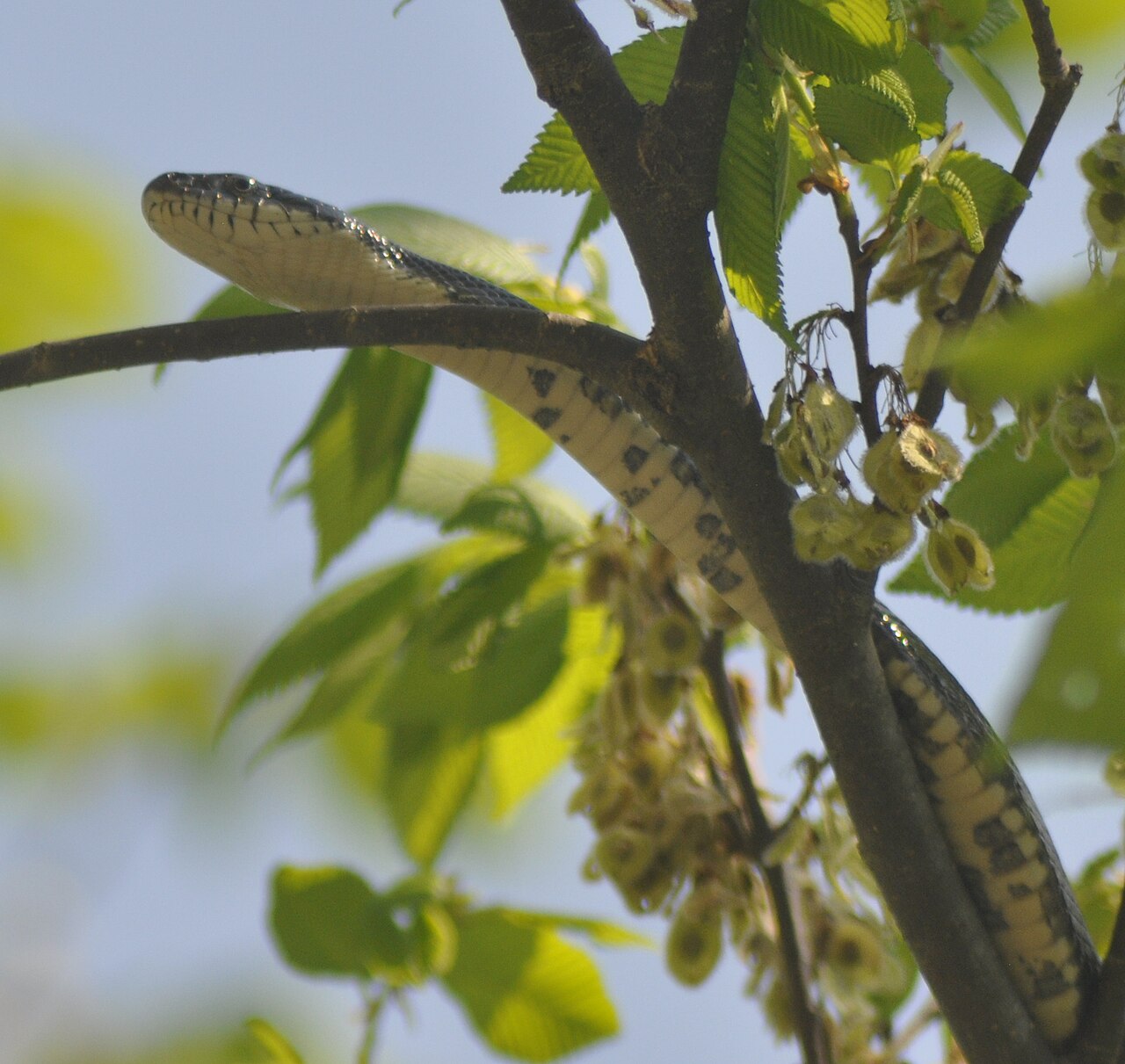
Rat snakes vary noticeably in color depending on region and age. Adults across much of the eastern United States are typically glossy black with white or cream on the chin and throat; in other regions rat snakes appear yellow, gray, or greenish with dark stripes. A key body-shape clue is the cross section: rat snakes have a somewhat flattened belly that meets the sides of the body at an angle, giving them a loaf-of-bread profile, an adaptation that helps them grip bark while climbing. Juveniles look strikingly different from adults, showing a bold, blotched gray or light brown pattern that fades into the adult coloring as the snake matures, which is why a young rat snake is often misidentified as an entirely different species.
If you find droppings near where you spotted a rat snake, see our guide to snake poop identification to confirm what you are looking at.
Not every snake in a backyard is wild; escaped or released pet snakes, including popular pet species like the banana ball python, are occasionally mistaken for native snakes.
Rat snakes share territory with many smaller reptiles, including the blue-tailed skink, a common and harmless lizard often mistaken for something more dangerous.
Is a Rat Snake Venomous or Dangerous?
No. According to the NC Wildlife Resources Commission, the rat snake is non-venomous, and a bite from even a large individual is no more severe than a scratch from a thorny branch. Rat snakes have round pupils, unlike the vertical, slit-like pupils of venomous pit vipers such as copperheads and rattlesnakes, and they lack the heat-sensing facial pits that vipers use to detect prey. They kill by constriction, coiling around prey and squeezing to cut off circulation and breathing rather than injecting venom. Rat snakes will bite defensively if grabbed, cornered, or restrained, but they are not aggressive toward people and will flee or freeze rather than attack when given the chance.
Why Rat Snakes Mimic Rattlesnakes
When threatened, a rat snake will often coil into an S-shape, hiss, and rapidly vibrate its tail against dry leaves or debris, producing a buzzing sound that closely resembles a rattlesnake’s warning rattle. Biologists call this Batesian mimicry, where a harmless species imitates a dangerous one to deter predators. It works well enough on predators, but it also means rat snakes are frequently killed by people who mistake the sound and defensive posture for a genuinely venomous snake, even though the two are easy to tell apart once you know the pupil and body-shape differences above.
What Do Rat Snakes Eat?
True to their name, rodents make up the bulk of a rat snake’s diet: mice, rats, voles, chipmunks, and even full-grown squirrels have all been documented as prey. Rat snakes are also skilled, semi-arboreal climbers, and they use that ability to raid bird nests for eggs and nestlings, which is the source of the nickname “chicken snake” among farmers whose coops occasionally lose eggs to a resident rat snake, and one reason rat snakes are sometimes found coiled near pheasant or poultry enclosures searching for an easy meal. Smaller prey such as lizards and frogs round out the diet. Because rodents are also a major food source for birds of prey like owls and hawks, a healthy rat snake population helps keep the same rodent numbers in check that these other predators rely on.
How Rat Snakes Kill Their Prey
Rat snakes are constrictors, meaning they subdue prey by wrapping several coils of their muscular body around it and tightening with each exhale the prey takes, restricting blood flow and breathing until the animal loses consciousness. A persistent myth holds that constrictors crush or break their prey’s bones; in reality, death comes from cutting off circulation and oxygen rather than physical crushing. Snakes cannot chew or tear food apart, since they lack the limbs and jaw structure to do so, so prey is always swallowed whole, aided by recurved teeth that grip and guide the meal toward the back of the mouth and a highly flexible jaw.
Are Rat Snakes Good to Have Around?
From a pest-control standpoint, rat snakes are genuinely valuable. Farmers have long recognized their worth as rodent control, and some deliberately tolerate or even relocate rat snakes into barns, cribs, and outbuildings specifically because they reduce mice and rat populations that would otherwise damage stored grain and spread disease, the same logic that leads some property owners to encourage owls to nest nearby. The trade-off that gives rat snakes their more mixed reputation is their taste for eggs and chicks, which makes them unwelcome around active chicken coops even while they are helping control the rodents that would otherwise raid the same coop for feed.
Rat Snakes and Backyard Bird Nests
Because rat snakes climb so well, they are one of the more significant nest predators that backyard birders contend with, capable of reaching cavity nests and nest boxes several feet or more off the ground that would stop most ground-based predators entirely. A snake-proof baffle mounted below a nest box, similar in concept to a squirrel baffle on a bird feeder pole, is one of the more effective ways to protect cavity-nesting species like bluebirds and chickadees without harming the snake itself. This is worth factoring into any broader plan to attract nesting birds to a yard, since a food-rich, shelter-rich backyard that attracts songbirds can just as easily attract the rodents and, in turn, the rat snakes that follow them.
Rat Snake Behavior and Habitat
Rat snakes are highly adaptable, found in forests, farmland, rocky outcrops, and increasingly in suburban neighborhoods, sheds, and attics, since their climbing ability lets them exploit gaps that many other snakes cannot reach. They are most active during the day in spring and fall but shift to nocturnal activity during the heat of summer. As cold-blooded reptiles, rat snakes cannot generate their own body heat and become dormant through the winter, often hibernating communally with other rat snakes beneath rock piles or underground burrows, a behavior well documented by state herpetological societies and university extension wildlife programs that track reptile hibernation sites, emerging on unusually warm winter days for brief activity before returning to shelter.
Rat Snake vs Other Common Snake Look-Alikes
Rat snakes are frequently confused with the black racer (Coluber constrictor), a smaller, faster-moving, and more slender snake that lacks the flattened, loaf-shaped body cross-section of a rat snake and has smooth rather than weakly keeled scales. Racers also tend to be more active and quicker to flee than the comparatively deliberate rat snake. In parts of the southeastern coastal plain, rat snakes take on a greenish color with dark stripes rather than solid black, which can further complicate identification for anyone used to the black form. When in doubt, the round pupils and non-aggressive, climbing-focused behavior remain the most reliable non-venomous indicators across all these variations.
Rat Snake Reproduction and Lifespan
Mating typically occurs in late spring, and females lay a clutch of roughly 6 to 28 eggs in mid to late summer, often in rotting logs, mulch piles, or loose soil where the warmth speeds incubation. Eggs generally hatch after about 5 to 10 weeks depending on temperature, and hatchlings emerge fully independent with no parental care, immediately capable of hunting small prey on their own. In the wild, rat snakes can live for a decade or more, and captive individuals, including the popular corn snake, a rat snake species widely kept as a docile beginner pet, regularly live 15 to 20 years with proper care.
What to Do If You Find a Rat Snake in Your Yard or House
In almost every case, the right response to a rat snake is to leave it alone or gently encourage it to move along, since it is doing free rodent control and poses no real threat. If one has gotten into a house, it usually followed a rodent scent trail through a gap, and the most effective long-term fix is sealing entry points and reducing the rodent activity that attracted it in the first place, rather than repeatedly removing snakes that will simply be replaced by new ones as long as mice are present. If a rat snake needs to be relocated, a licensed wildlife control operator can do so safely; grabbing or cornering the snake yourself is the most common way people get bitten, entirely avoidable by simply giving it space and an exit route.
Related reading: Banana Ball Python.
Related reading: Hognose Snake.
Related reading: Milk Snake.
Related reading: Texas Rat Snake.
Related reading: Black and White Snake.
Related reading: King Snake.
Related reading: Coral Snake vs King Snake.
Related reading: Ring Neck Snake.
Related reading: Garter Snake Bite.
Related reading: Garter Snake.
Related reading: Bull Snake.
Related reading: Rough Green Snake.
Related reading: Diamondback Water Snake.
Frequently Asked Questions
Is a rat snake dangerous to humans?
No. Rat snakes are non-venomous constrictors that pose no real threat to people. They may bite defensively if handled or cornered, but the bite is not medically dangerous, comparable to a scratch rather than a venomous strike.
How can you tell a rat snake from a venomous snake?
Rat snakes have round pupils and lack the heat-sensing facial pits of venomous pit vipers, which instead have vertical, slit-like pupils. Rat snakes also have a distinctive flattened, loaf-shaped body cross-section adapted for climbing.
What do rat snakes eat?
Rat snakes primarily eat rodents such as mice, rats, voles, and chipmunks, along with birds, bird eggs, lizards, and frogs. Their climbing ability lets them raid tree cavities and nest boxes for eggs and nestlings.
Why does a rat snake shake its tail?
Vibrating the tail against dry leaves produces a buzzing sound that mimics a rattlesnake’s rattle, a defense called Batesian mimicry meant to scare off predators. It is a bluff, since rat snakes have no rattle and are non-venomous.
How big do rat snakes get?
Most rat snakes reach 3 to 6 feet as adults, with some individuals and species growing up to 8 feet, making them among the longest snakes in North America.
Should I kill a rat snake I find in my yard?
No. Rat snakes provide valuable, free rodent control and are not dangerous to people. The better long-term approach is sealing up entry points and reducing rodent activity around the home, which addresses why the snake was there in the first place.
How long do rat snakes live?
Wild rat snakes can live a decade or longer, while captive rat snakes, including the popular corn snake, commonly live 15 to 20 years with proper care.